
Reviewed · POMPEII TOURS
Pompeii: Tour with Archaeologist Guide & Skip-the-Line Entry
Pompeii is interesting because you can walk through an ancient Roman city that survived nearly intact after the eruption of Vesuvius in 79 AD. This tour gives you priority access, so you spend less time standing in lines and more time reading the stones. You also get context that helps the ruins feel like a real place, not just a photo backdrop.
What I like most is the focus on Pompeii’s everyday life, from city spaces to buildings tied to food, bathing, and social habits. The other big win is the official archaeologist guide, plus skip-the-line Pompeii Express entrance so your visit starts faster. When I look for value in a short tour, this is one that actually uses its time well.
One consideration: this experience is not suitable for wheelchair users or people with mobility impairments, and the site walk can be demanding. Also, it’s about two hours inside the excavations, so you will not see everything at a slow pace.
Key points before you go

- Archaeologist guide: live interpretation that turns ruins into stories about daily life.
- Skip-the-line entry: priority access helps you use your limited time.
- Clear stop sequence: gates, theater, a named house, shops, baths, a lupanare, and the forum.
- Headsets in larger groups: radioguide kicks in when the group is over 8 people.
- Free time at the forum: a short window to wander and reset your bearings.
Pompeii, explained like a real city, not a museum line
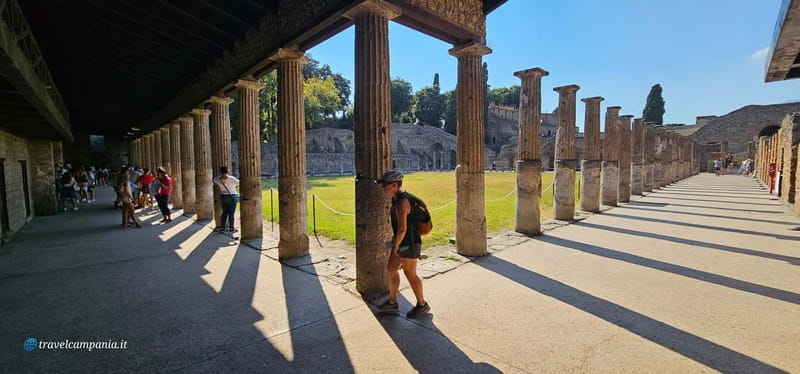
Pompeii is the rare UNESCO site where you can see an ancient place almost whole. The eruption buried buildings, streets, and objects under ash and debris, and that preservation is exactly why Pompeii still feels unusually legible today. You are not just looking at ruins, you are looking at rooms, corners, and public spaces that once had routines built into them.
That is the core reason this format works. A guided route helps you notice patterns. Where a solo visit can turn into, Here is a wall, here is a doorway, here is another wall, this tour pushes you to connect the dots. With an archaeologist guide, the buildings become evidence. You start to understand why the city was laid out the way it was, and why certain spots matter.
The skip-the-line part is also practical. Pompeii can be busy, and ticket queues can eat a chunk of your day. Priority entry does not make the site magically less crowded, but it protects your start time, and that changes how relaxed your visit feels.
More of Pompeii:
- Pompeii: Entry Ticket and Guided Tour with an Archaeologist
★ 4.8 · 19,459 reviews - Pompeii: Skip-the-Line Entrance Ticket with Audio Guide
★ 4.0 · 2,509 reviews - Naples: Pompeii and Mt. Vesuvius with Lunch and Wine Tasting
★ 4.5 · 2,454 reviews
Getting started at the Welcome box and how the tour runs
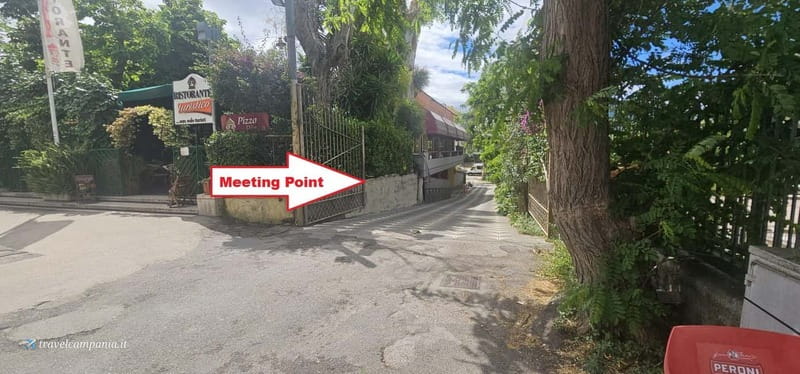
The tour starts at the Welcome box and ends back at the meeting point. You meet the guide, and then you begin walking through the excavated areas on a structured path. The whole time in the excavations is about 2 hours, with planned stop durations that keep the group moving without feeling like a sprint.
Language options matter here. You can have live guiding in Italian, Spanish, French, English, or German. If your group is bigger (over 8 participants), you get a radioguide system for listening. If the group is smaller (up to 4 people in the same language), the setup shifts to an audio guide plus an English tour guide.
Also, plan for the audio. Some people find the earpieces loud, but they can be essential in a busy site. If you have sensitive hearing, it’s smart to bring your own comfort gear, like simple earplugs, and still rely on the headset when the guide is speaking.
When it comes to guides, you may see names like Angelo (Travelcampania) or other guides mentioned by name such as Teresa, Lilian, Paolo, Mario, Imme, and Roberta. The common thread is the delivery style: jokes, pacing, and the ability to explain what you are seeing in plain terms.
Porta Marina: how you read the city before you go inside it
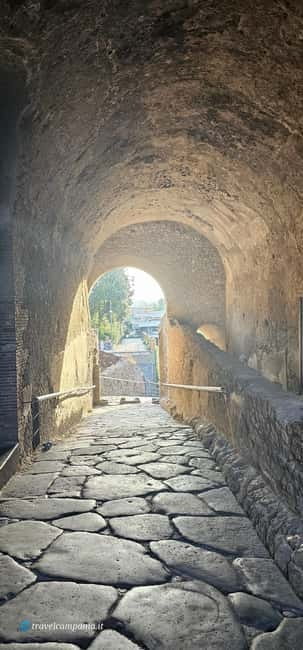
Stop 1 gets you moving right away. You start the route at the Porta Marina area of Pompeii, and this first segment is about 10 minutes. I like this opening because it gives you a framework for the rest of the visit.
Early stops are where you learn what to look for. Guides often set the tone here by explaining how Pompeii operated as a city, including its long timeline. Pompeii is described as tracing back to the 7th century BC, and the guide uses that context to make the later eruption story hit harder.
Potential drawback: the beginning is short. If you are the type who wants slow questions and extra photos, you may feel slightly rushed at the first stop. The tradeoff is that you get more stops during the 2-hour window.
Still, I think starting at a gate area is the right move. It helps you treat the ruins as connected streets and neighborhoods, not isolated attractions.
Teatro Piccolo: the power of explaining what you’re actually looking at
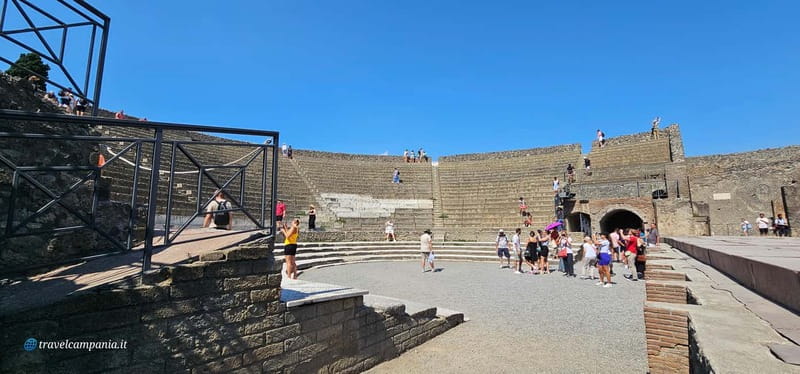
Next you hit the Teatro Piccolo for about 10 minutes. This is a great example of why a specialist guide changes things.
A theater ruin can look like random stone seating if you are not given a little interpretation. With a guide, you start to understand what public entertainment meant in Roman life, how spaces worked, and why the layout matters. Even if you do not care deeply about ancient drama, you get a mental model of social life in Pompeii.
What I like here is the balance. The stop is brief, so you see it without getting stuck, but the guide uses the time to connect it to everyday culture rather than treating it like a decorative stop.
Tip for you: stand where the guide indicates, even if it feels like a crowd magnet. In a site this crowded, the guide often chooses spots that let you see details without everyone blocking everyone else.
More Pompei Campania bookings worth a look
- Pompeii: Skip-the-line-Ticket and Guided Tour
★ 4.6 · 1,152 reviews - Pompeii: Guided Tour with Skip-the-Line Entry
★ 4.9 · 812 reviews - Pompeii: Skip-the-Line Entry Ticket with Digital Guide App
★ 4.1 · 770 reviews - Pompeii: Afternoon to Sunset Guided Tour with Ticket
★ 4.9 · 484 reviews
House of Menander: how a famous home turns into a daily-life lesson
The House of Menander is next, with about 15 minutes. “House” stops can go two ways on tours. Either you see the exterior and a few rooms, or you learn why the house layout tells you how people lived.
With a guide, you get the second option. You are not just touring a label. You’re learning what different spaces would have been used for, and how Pompeii’s inhabitants organized their world in a practical, human way. The tour also includes talk about objects and artifacts, and Pompeii is well known for preserved details, including plaster casts created from remains.
A possible consideration: houses can be visually dense. If you are prone to information overload, focus on one theme the guide emphasizes, like movement through rooms or the relationship between private and public areas. That one focus is often enough to make the house stop feel coherent.
Thermopolium: the food stop that makes the city feel real

At the Thermopolium you get about 15 minutes. This is one of the best stops for getting the city to feel like it had a heartbeat. Food and drink places are where ancient life becomes relatable.
A thermopolium is not just a building with counters. It is a snapshot of routine: people buying food, grabbing something quick, and interacting with staff. When the archaeologist guide explains the setting, the counters and entry points stop being “cool ruins” and start being “this is how people ate.”
I also like this stop because it breaks the pattern. After gates and a theater, a food-related place refreshes your attention. It keeps the tour from feeling like only temples and big structures.
Terme Stabiane: baths that teach you about community and comfort
Then you move to the Terme Stabiane for about 15 minutes. Baths are one of the clearest windows into social life in the Roman world, and a Pompeii guide can help you read the space as a system.
Instead of seeing it as a pile of stone, you learn how public bathing worked and what the building design suggests about daily habits. This stop is often where the tour shifts from history lesson to human behavior. People did not live in text books. They lived in places designed for routine.
Practical note: baths can be busier than you expect because they are memorable. If the guide offers to position you or timing you so you do not fight the crowd, take the advice. The route often includes choices that help you see less congested areas.
Lupanare: a frank stop that benefits from expert context
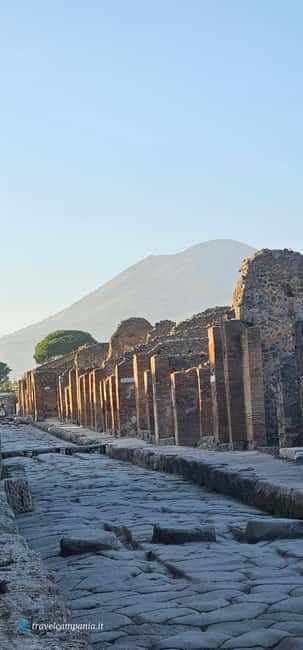
The Lupanare comes next, with about 20 minutes, which is longer than most stops. That extra time makes sense. The lupanare is a building category that many visitors find instantly intriguing, but it also needs careful explanation to be meaningful rather than sensational.
A guide helps you understand the space through the lens of archaeology and everyday life. You learn what the building suggests about commerce, social interaction, and how people moved through it. The best part is you get to treat it as a historical site, not gossip bait.
Possible drawback: if you prefer lighter topics, this is not the softest stop. The tour length helps, because you are not stuck there for too long. Still, it is smart to mentally prepare for a more direct slice of Roman society.
Foro Civile di Pompei: the big public stage, plus a breather
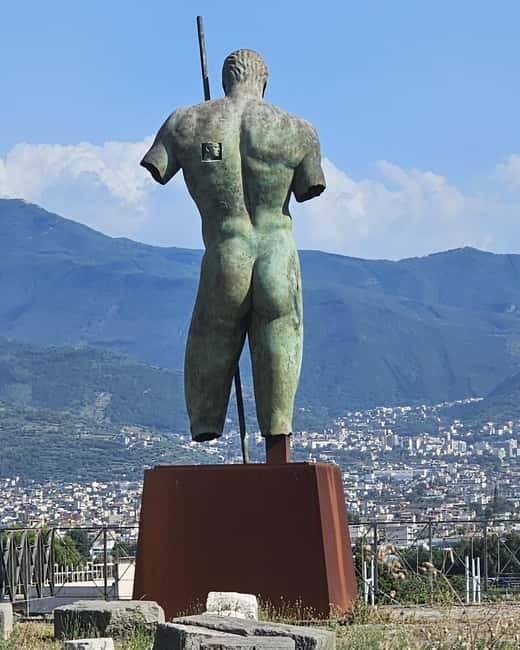
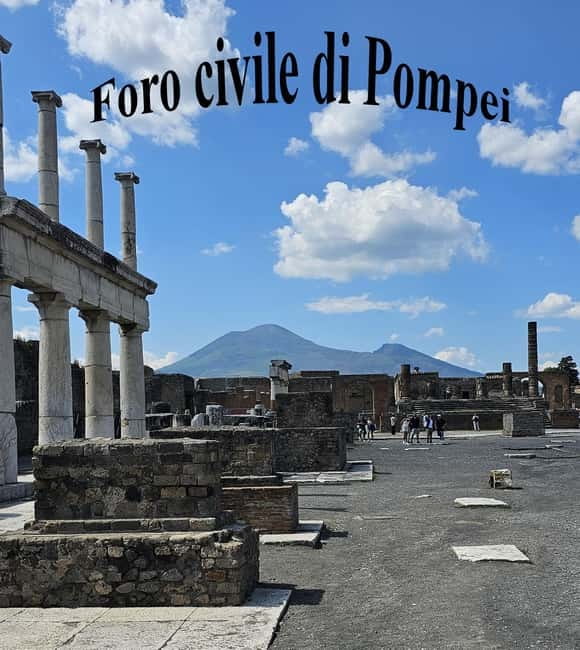
The route then reaches the Foro Civile di Pompei for about 15 minutes, followed by 10 minutes of free time back in the forum area. This is a strong end cap because the forum is where public life clusters.
The guided part helps you learn what to look for and why it mattered. The free time afterward is the moment that turns the tour into a tool for the rest of your visit. You can circle back to what made the most sense, take extra photos, or slow down if something clicked during the explanation.
I recommend using the free time for orientation. When you leave a site like Pompeii, you want to remember where you are relative to the main clusters. Even a quick self-guided loop in the forum area can make your remaining time feel more confident.
How the tour handles crowds: headsets, smart pacing, and real logistics
This tour is designed for efficiency, but it is still inside one of the most famous ruins in the world. Crowds happen, and the good news is the system is built for that.
If your group is larger, the tour includes radioguide support for listening as you pass through the most crowded points. Some people find the headsets loud, but they make a difference when you cannot reliably hear a guide over moving crowds.
Pacing is also part of the value. You get a stop list with times, so you do not waste energy guessing what comes next. One review style theme that shows up again and again is that the guide can steer the group toward spots that are easier to see, which matters when Pompeii is packed.
On the practical side, check in can be the only annoying part. One common friction point is difficulty spotting the meeting spot when you arrive. Use the details you have for the Welcome box, and give yourself a few extra minutes.
Price and value for a 2-hour archaeologist-led circuit
At $57 per person for about 2 hours, the value comes from two things: the official archaeologist guide and the Pompeii Express entrance ticket with priority access.
If you went solo, you would still face ticket lines, and you would need to do the research yourself to get the same context. Here, you get the city explained for the time you actually have. The tour also gives you plaster cast context and a guided path through multiple building types, which is exactly what makes the site click faster than wandering.
You do need to match your expectations to the format. This is not a full-day Pompeii deep study. It is a focused, structured intro that gives you enough understanding to enjoy the rest of the ruins afterward if you have extra time.
Who should book this Pompeii tour, and who should skip it
This tour is a good fit if you:
- Want a clear, guided route that covers major parts of Pompeii in about 2 hours
- Prefer expert interpretation over trying to connect the ruins on your own
- Would benefit from headsets, especially if you travel with a group
It’s not a good fit if you:
- Need wheelchair access or have mobility limitations, since it is listed as not suitable for wheelchair users and those with mobility impairments
- Want a long, slow wandering day. Two hours moves, even with short stops
If you are traveling with kids, it can work if everyone can handle the pace, but note that you are asked to provide the names and ages of participants.
Quick packing list and on-site tips that actually help
Bring:
- Passport or ID card. Copies are accepted, and you also need the same for children.
- Your group participant details, since the names and ages must be provided.
Not allowed:
- Bikes
- Bags
- Alcohol and drugs
A couple of real-world tips from how people experience the site:
- There are free lockers at the gates to store a backpack safely.
- There are water fountains, though they may be unmarked, so it helps to keep an eye out.
Shoes matter. Even without exact distance details, Pompeii’s ground is uneven and you are in historic excavations. Plan for comfort, not style.
Should you book? My honest call
Book this tour if you want Pompeii to make sense fast. The archaeologist guide plus priority entry is a strong combo for a short visit. I especially like that the route hits multiple everyday-life categories: theater, homes, a food shop, baths, and the forum, with a forum break that helps you reset and explore after the guided portion.
Skip it if you need accessibility support or if you prefer long, unstructured time over a scheduled stop sequence. Also, if you hate headsets or loud audio, plan how you will handle it, since the radioguide system can be used when your group is larger.
If you are aiming to get the most meaning per hour at Pompeii, this is one of the easier choices to back.
FAQ
How long is the Pompeii tour with an archaeologist guide?
The tour lasts about 2 hours, with the exact start times depending on availability.
Does this tour include skip-the-line entry?
Yes. It includes a Pompeii Express entrance ticket with priority access to skip long ticket lines.
What is included in the price?
You get the Pompeii Express entrance ticket and an authorized expert archaeology guide.
What languages are available?
The live tour guide is offered in Italian, Spanish, French, English, and German.
Will there be a radioguide or audio system?
The tour includes a radioguide when passing 8 participants. If the group is not over 4 participants in the same language, it uses an audio guide plus a tour guide in English.
What should I bring?
Bring your passport or ID card. Copies are accepted, and you also need the same for children.
Are bags allowed in Pompeii on this tour?
No, bags are not allowed.
Is it refundable if I cancel?
Yes. You can cancel up to 24 hours in advance for a full refund.
Reviewed lately around Pompei Campania
- Pompeii: Afternoon to Sunset Guided Tour with Ticket★ 4.9 · 484 reviews
- Pompeii 3hours Villa of Mysteries tour with an Archaeologist★ 4.8 · 486 reviews
- From Pompeii: Bus Transfer to Vesuvius with Park Entry Fee★ 4.2 · 700 reviews
- Pompeii: Skip-the-Line Entry Ticket with Digital Guide App★ 4.1 · 770 reviews
- Pompeii: Guided Tour with Skip-the-Line Entry★ 4.9 · 812 reviews
- Pompeii: Small-Group Tour of Pompeii and Herculaneum★ 4.8 · 867 reviews
- Pompeii: Skip-the-line-Ticket and Guided Tour★ 4.6 · 1,152 reviews
- Naples: Pompeii and Mt. Vesuvius with Lunch and Wine Tasting★ 4.5 · 2,454 reviews
Pompeii Tours, compared.
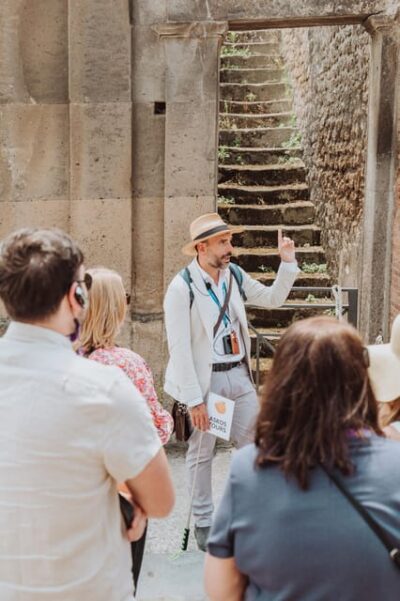
Pompeii: Entry Ticket and Guided Tour with an Archaeologist
Read our review →
Pompeii: Entry Ticket with Optional Audio Guide
Read our review →


Pompeii Small Group Tour with an Archaeologist
Read our review →
Pompeii, Amalfi Coast and Positano Day Trip from Rome
Read our review →
Pompeii and Mount Vesuvius Day Trip from Rome with Pizza Lunch
Read our review →Browse the lists this tour appears in