

Reviewed · POMPEII TOURS
Pompeii: Exclusive Tour with Archaeologist and Entry Tickets
Pompeii has a strange power. One minute you are standing in ordinary sunlight, the next you are walking streets that stopped in 79 AD when Vesuvius erupted. I love how this tour keeps the pace tight and the story human, with real guides such as Livio and Antonio bringing the site to life as you move from place to place.
Two things I like a lot: first, the skip-the-line entry so you actually get Pompeii time, not line time. Second, you are not left to guess what you are seeing, because the route is led by a licensed archaeologist with headsets. One drawback to keep in mind is the format is only 2 hours, so it is a focused best-of plan, not a full-day, see-every-corner wander.
Key Pompeii moments you will hit (and why they matter)
- Porta Marina gate start for a clean entry and quick orientation at the original Roman gateway
- Forum and civic stops that explain how politics, religion, and daily life worked together
- Temples on the main axis like Jupiter and Apollo to show what Pompeians worshipped and why
- Macellum market plus plaster casts so the tragedy feels personal, not just dramatic
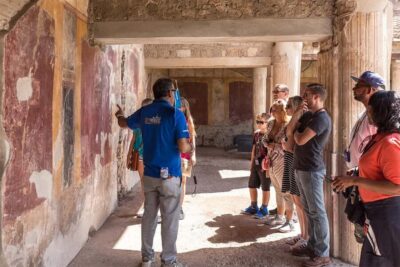
- High-status homes and wall art including the House of the Vettii and the House of the Faun for what Pompeians chose to display
- Theatre district and Lupanare to round out the city beyond temples, with a sobering look at nightlife and entertainment
What This Pompeii Tour Does Better Than a Typical Walk
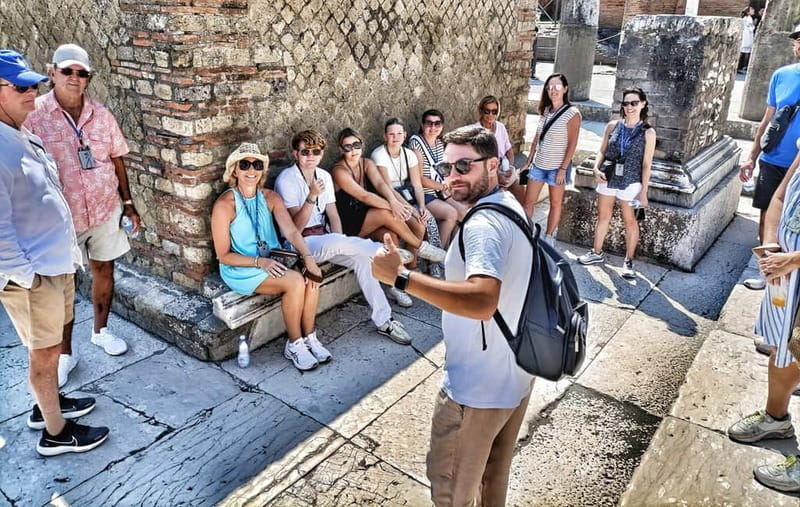
Pompeii is big enough that your brain needs help. Without a plan, it is easy to bounce from one famous photo spot to another and miss the way the city actually fit together. With this experience, you get a guided route that hits the major anchors, then adds specific context so the streets start making sense fast.
This is also a smart choice if you do not want to spend your best morning or afternoon thinking about logistics. You meet outside Porta Marina near the Pompei Scavi – Villa dei Misteri (Circumvesuviana) station, you grab a headset, and you head in with a group that stays tight enough to move.
And yes, the guide quality tends to matter here. Many guides, including Livio, Ivan, Ricardo, Raffaele, and Loredana, are described as engaging and professional, with a clear focus on explaining daily life as much as the eruption and excavations.
Skip-the-Line Entry and Headsets, Why It Changes Your Experience
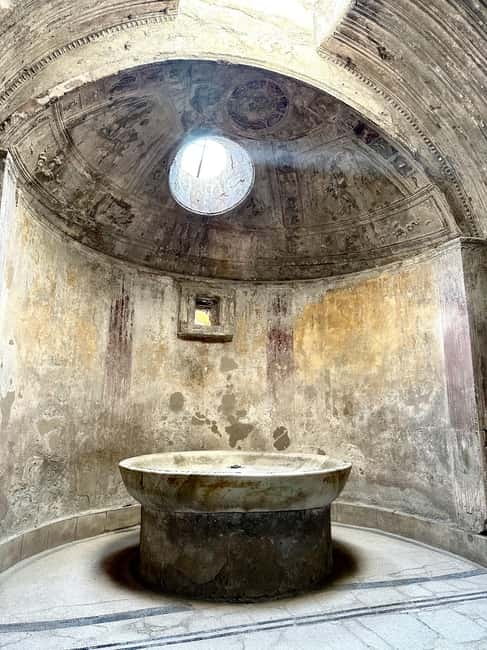
The headline for most people is simple: you skip long ticket queues and get into the park sooner. That matters because Pompeii time feels short no matter when you go. When you are spending energy waiting, you lose the best part, that first stretch when the ruins still feel fresh and exciting.
Headsets are the underrated win. In a site where you are often walking, turning, and stepping around crowds, having audio that stays clear keeps you from missing the small but important details. It also means you can focus on what your feet are seeing, instead of constantly scanning for the guide.
If you want the tour to set you up for the rest of the day, this helps even more. One reason people come away happier is that the guide points out what to look for after the guided portion ends, so you are not wandering blind.
More of Pompeii:
- Pompeii: Entry Ticket and Guided Tour with an Archaeologist
★ 4.8 · 19,459 reviews - Pompeii: Entry Ticket with Optional Audio Guide
★ 4.2 · 12,360 reviews - From Naples: Pompeii Ruins & Mount Vesuvius Day Tour
★ 4.3 · 11,459 reviews
Meeting at Porta Marina, Then Moving Like You Know the Place
Your start is straightforward. You meet outside the Porta Marina entrance where it sits in front of the train station Pompei Scavi – Villa dei Misteri. Your guide holds a sign that says Pompei VIP, which makes the first 5 minutes less stressful.
From that entry point, you begin at the city’s threshold and work inward. That route choice is practical. You are not trying to locate landmarks across a sprawling site, and you are less likely to feel lost in the first minutes.
Also, because this is built for a short time window, expect a steady walking pace with frequent explanations. The goal is not to linger in one spot for an hour. The goal is to connect the dots across multiple districts.
Basilica and the Forum Civile di Pompei, Where Roman Life Had a Pulse
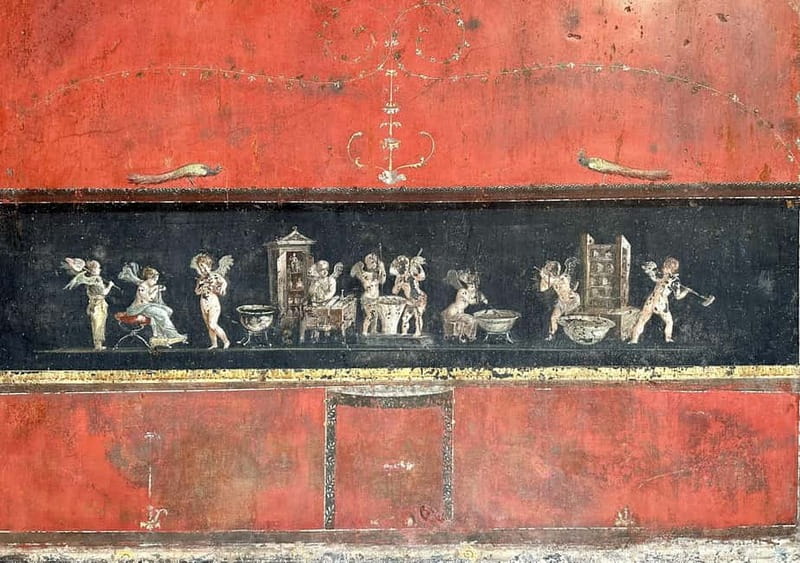
The early stops set the tone. You begin with key civic spaces, so you understand what you are looking at before you start naming buildings like a quiz.
The Basilica was central to civic activity, and your guide uses it to explain how public space worked in everyday terms. The Forum Civile di Pompei then functions like the big classroom. Here you learn how political debate, religious practice, and commerce blended into one shared hub.
This is one of the best reasons to book a guided plan rather than a self-walk. A lot of Pompeii looks like stones and arches until someone gives you the social map. Once you get that map, the same ruins start feeling purposeful, not random.
Temples of Jupiter and Apollo, Plus What Religion Looked Like in Street Form
Next come the religious anchors: the Temple of Jupiter and the Temple of Apollo. These are not just pretty facades or roofless shells. They help you grasp how belief was built into the city’s daily rhythm.
Your guide will connect the temples to broader civic identity. In Pompeii, religion was not tucked away in a distant hillside sanctuary. It was part of the main walk, part of the way people gathered and announced what mattered.
If you are the type who likes seeing why buildings were placed where they were, you will enjoy this section. If you prefer only domestic scenes, you might feel the religious stops take up time, but they really do explain the rest of what you see.
More Pompeii bookings worth a look
- From Naples: Pompeii Skip-the-Line Entry Ticket and Tour
★ 4.4 · 2,753 reviews - Pompeii: Skip-the-Line Entrance Ticket with Audio Guide
★ 4.0 · 2,509 reviews - Pompeii: Archaeological Park Tour with Ticket on request
★ 4.5 · 2,283 reviews - Pompeii: Guided Walking Tour with Entrance Ticket
★ 4.3 · 1,423 reviews
Forum Baths and a City Built for Routine
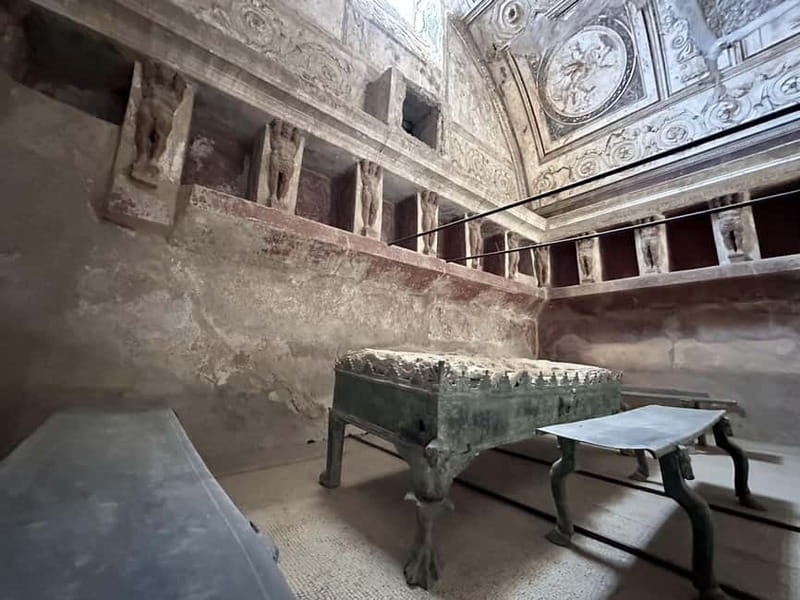
Bathrooms and water access might not sound like the most thrilling topic on a first read, but the Forum Baths change the way you picture Pompeii. These spaces help you understand that daily life had routines, and those routines were public enough that you could learn a lot just from how people used shared facilities.
This stop is also a good pacing break. You get shade sometimes, you get a change of pace in the walking flow, and you get to think about what kind of city this was. Pompeii was not only about tragic death. It was also about routine.
Macellum Market and Plaster Casts, When the Site Turns From Amazing to Unsettling
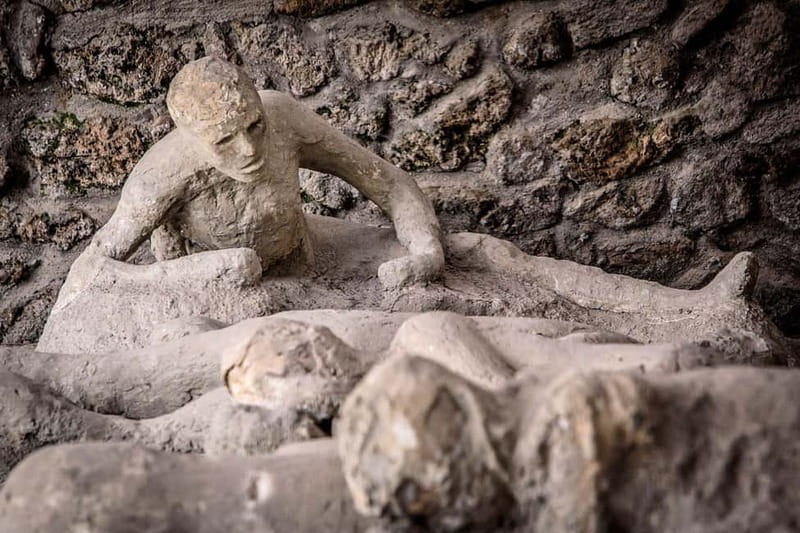
Then you reach one of the most emotionally powerful portions: the Macellum market area, paired with the plaster casts of victims. This is where the human stories become concrete.
The point is not to scare you. The point is to give the tragedy a shape. When you stand where a market functioned and you are then confronted with casts that represent people lost in the eruption, the whole eruption story stops being abstract.
Your guide’s job here is crucial. A good explanation keeps the tone respectful, while still giving you enough context to connect what you see to what happened. Guides like Ricardo and Antonio have earned praise for balancing story, science, and clarity, which is exactly what you want in this section.
Houses With Frescoes and Mosaics, What People Actually Chose to Display
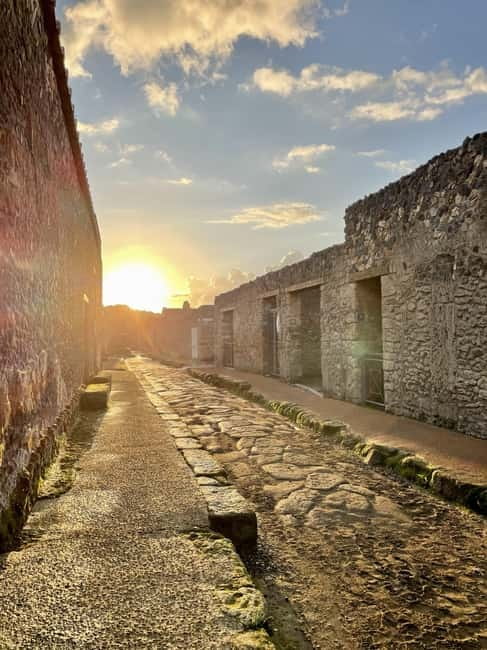
After civic spaces and the market, you shift into domestic Pompeii. This is where art and daily taste come into view, and where you feel the difference between “a city” and “people living in it.”
You will visit several well-known homes, including the House of the Tragic Poet, the House of the Vettii, and the House of the Faun. These stops matter because they show how Pompeians treated their walls, courtyards, and floors as part of identity.
The House of the Vettii is a highlight for wall and decorative detail, while the House of the Faun is often remembered for its standout artistic features. In both places, the value of the archaeologist guide is you do not just look at decoration. You learn what it might have signaled about status, culture, and self-image.
Drawback to note: domestic areas can require you to walk through sections with uneven ground and tight paths. Comfortable shoes matter, and if you get motion sensitive, know that this is a walking-focused tour.
Lupanare and the Theatre District, Entertainment Beyond the Postcard
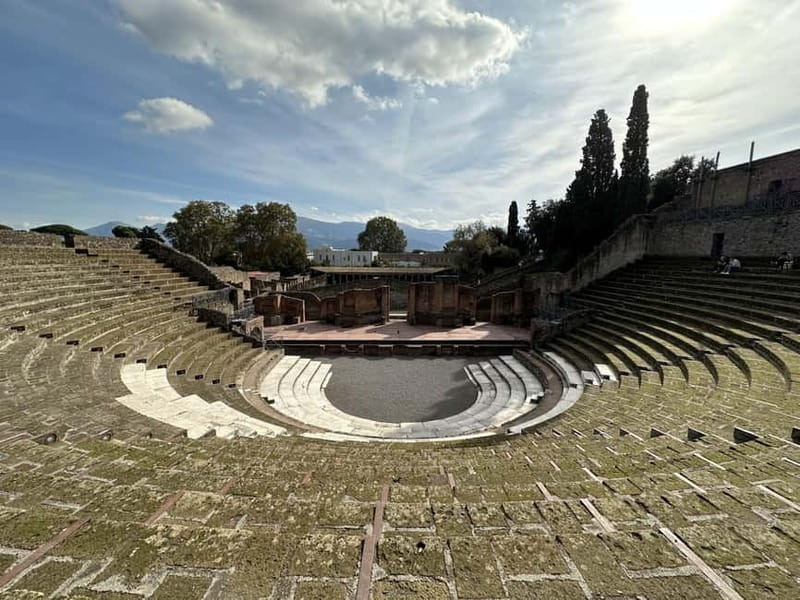
This is where the tour helps you escape a too-clean version of Pompeii. You get a stop at the Lupanare, a site tied to prostitution, and a visit to the Large Theatre within the Theatre District.
Why is that included in a “best of Pompeii” route? Because it rounds out the city. Pompeii was not only temples, baths, and rich homes. It also had nightlife, performance, and the everyday commerce of attraction.
If you are sensitive about mature subject matter, this stop might feel uncomfortable. But skipping it can also leave you with a partial picture. I appreciate that the tour treats Pompeii like a real city with real contradictions, not a sanitized theme park.
The Value of the 2-Hour Route, What You Gain and What You Might Want Later

Two hours goes quickly. That is the trade. You are getting a high-impact overview with the most important zones and an explanation that connects them. The big win is you leave with a mental framework, so you can continue on your own afterward without feeling like you are just reading plaques.
People who want to return for more tend to do so because they now know what to look for. The guide’s last step, pointing out must-see places after the tour with the group, is designed for exactly that. If you only have one visit slot to Pompeii, this timing can feel perfect.
If you have a full day in Campania and you want unhurried exploration, you may still want a longer format. But as a first shot at Pompeii, this 2-hour plan is a smart use of time.
Price and What Makes It Feel Fair at $50
$50 per person for a 2-hour guided visit with entry tickets included is not the cheapest way to do Pompeii. It is also not an impulse buy.
Here is why it can feel fair: you get skip-the-line entry, you get a licensed archaeologist, you get headsets, and you get a small-group format plus a private option if you choose it. Those items reduce friction and raise the quality of your viewing time.
If you would otherwise be paying for tickets and then hiring a guide locally, you would likely spend similar money. The main difference is that this route is built to be efficient, so your money buys time in the ruins, not time planning it.
Who This Tour Fits Best (And Who Might Prefer Something Else)
This is best for you if you like structure, want a guided context fast, and prefer a smaller group. The language options also help, with tours available in English, Italian, French, and Spanish.
It is not a fit for people with mobility impairments or wheelchair users. The tour is explicitly not suitable for wheelchairs, and Pompeii terrain is uneven.
If you are traveling with kids, this can be a good choice because the pacing is designed for a short attention window. One more reason: guides tend to keep explanations engaging and clear, and the headset makes it easier for everyone to follow along.
A Note on the New Ticket Name Rule, Because It Affects Real Entry
There is one practical thing to know before you go. The Pompeii Archaeological Park has updated ticketing rules, effective from November 15. You will need to send the tour operator your full participant names and ages through the booking messaging system so your names can be added to the tickets.
Also bring ID. An ID or passport is required for adults and kids. Photo of ID is mentioned as fine, but do not show up without something valid.
This is the kind of rule that can ruin your day if you forget, so I treat it as part of the experience, not a footnote.
Should You Book the Pompeii VIP Archaeologist Tour?
I would book it if you want Pompeii to feel understandable within a short time. The mix of skip-the-line entry, headsets, and a route that hits major civic spaces plus domestic homes, market areas, and the theatre zone is the right formula for most first-timers.
I would think twice if you want a slow, wandering, every-street exploration where you stare at one mosaic for 45 minutes. With only 2 hours, you will be moving. But if you use that time well, you will finish with stronger direction for what to see next on your own.
If you can, pick a guide you like based on the general style you prefer. The names you might get, such as Livio, Ivan, Ricardo, Raffaele, Antonio, Loredana, Rafael, Pierluigi, and Monica, show a pattern: people value clear explanations, friendly engagement, and professional pacing.
If you are ready for Pompeii with a plan, this is a very solid way to get there.
FAQ
How long is the Pompeii tour?
It runs for 2 hours.
Where do I meet the guide?
Meet outside Pompeii’s Porta Marina entrance, in front of the Pompei Scavi – Villa dei Misteri (Circumvesuviana) train station. The guide holds a sign for Pompei VIP.
Is the entry ticket included?
Yes. Skip-the-line entry tickets and Pompeii’s admission Express ticket are included.
Do I need to pay extra for a guide?
No. The archaeologist and licensed guide are included.
Do I get audio support?
Yes. Headsets are included so you can hear the guide more clearly.
What language is the tour in?
The live guide is available in English, Italian, French, and Spanish.
Are food and drinks included?
No. Food and drinks are not included.
What should I bring?
Bring passport or an ID card, plus comfortable shoes and water.
Is this tour suitable for wheelchair users or people with mobility impairments?
No. It is not suitable for people with mobility impairments or wheelchair users.
What is the rule about names on tickets?
You must provide each participant’s full name and surname and ages through the booking messaging system so the tour can add them to the tickets, as required by Pompeii Archaeological Park rules starting November 15.
Reviewed lately around Pompeii
- Explore Pompeii with an Archaeologist★ 5.0 · 511 reviews
- From Sorrento: Pompeii Half-Day Skip-the-Line Tour★ 4.6 · 541 reviews
- Day Trip of Pompeii, Herculaneum and Vesuvius from Naples★ 4.5 · 547 reviews
- Day Trip of Pompeii, Sorrento and Positano from Naples/Salerno★ 5.0 · 560 reviews
- Pompeii Skip-the-line Tour with Archaeologist Guide★ 5.0 · 559 reviews
- Pompeii Private Tour with an Archaeologist and Skip The Line – 3 hours★ 5.0 · 564 reviews
- 3 Days in Sorrento, Capri & Pompeii: la Dolce Vita★ 4.0 · 595 reviews
- Sorrento & Pompeii Guided Day Trip from Rome with Optional Pickup★ 4.5 · 598 reviews
Pompeii Tours, compared.
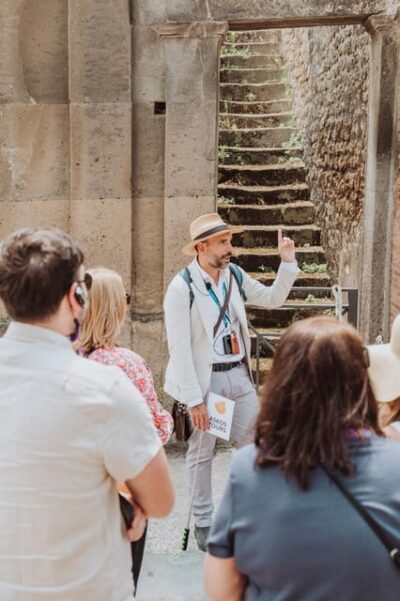
Pompeii: Entry Ticket and Guided Tour with an Archaeologist
Read our review →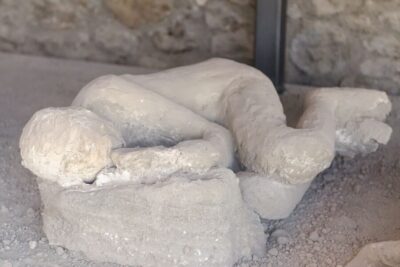
Pompeii: Entry Ticket with Optional Audio Guide
Read our review →


Pompeii Small Group Tour with an Archaeologist
Read our review →
Pompeii, Amalfi Coast and Positano Day Trip from Rome
Read our review →
Pompeii and Mount Vesuvius Day Trip from Rome with Pizza Lunch
Read our review →Browse the lists this tour appears in