
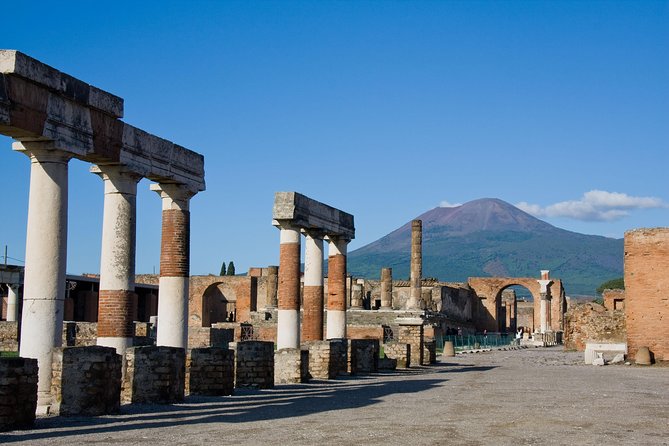
Reviewed · 2-HOUR EXPERIENCES
Pompeii 2h Small-Group Tour with Expert Archaeologist
Pompeii can feel like a maze, even when the ruins are jaw-dropping. This tour is built for time-crunched visits, so you get a smart route through the big must-sees in about 2 hours.
I especially like the way the guide helps you understand what you are looking at, not just where to stand. I also like the small-group feel (up to 30), which keeps the pace friendly enough for most people with moderate walking ability. One drawback to think about: because the visit is short, you will not see everything Pompeii offers, and a couple of reviews point to occasional mismatches when it comes to kids and hearing on headsets.
Key Highlights That Make This Tour Work
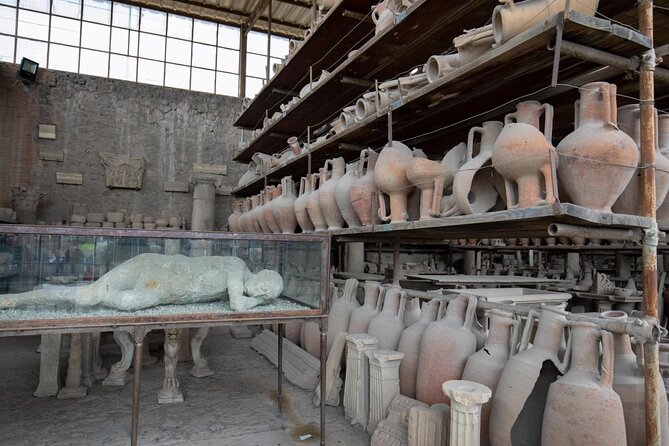
- A tight, highlight route: you hit famous theaters, major houses, baths, the forum, and more without wandering for hours
- Admission included: the tour covers your entry so you can focus on the ruins
- English-only guiding: clear explanations and route guidance when Pompeii’s layout gets confusing
- Guide storytelling that makes details stick: fans mention guides like Luca, Roberta, Manuela, and Patrizia bringing scenes to life
- Shade-smart pacing: some guides actively shift where they talk so the heat is more manageable
- Good “first Pompeii” option: it’s ideal if you want context before you explore on your own
A Two-Hour Route That Gets You Oriented in Pompeii
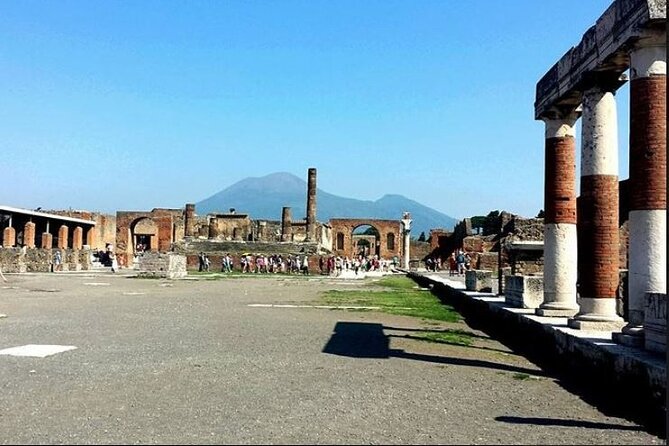
Pompeii is enormous, and that is the whole problem. If you go in cold, you can end up doing the classic thing: taking a few photos, walking a lot, and still leaving unsure what you just saw. This tour solves that by steering you through a focused sequence of stops, with a guide who explains the scenes as you go.
The best part is that you get structure. The route moves from major public spaces to grand private homes, then into daily life details like bathhouses and even the infamous Lupanar. You do not need to be an archaeology person to get value here. You just need to pay attention, and the guide will do the heavy lifting.
You also get a realistic expectation: two hours is enough for a strong overview and “wow” moments, not enough for an everything-you-can-see day.
More of Pompeii:
- Pompeii: Entry Ticket and Guided Tour with an Archaeologist
★ 4.8 · 19,459 reviews - Pompeii: Entry Ticket with Optional Audio Guide
★ 4.2 · 12,360 reviews - From Naples: Pompeii Ruins & Mount Vesuvius Day Tour
★ 4.3 · 11,459 reviews
Where to Meet at Piazza Esedra, and What to Expect on Arrival
You meet at Ristorante Suisse, Piazza Esedra 10/13, 80045 Pompei NA. The tour ends back at the same meeting point, which makes it easy to pick up the rest of your day without solving your own exit puzzle.
Because the tour operates with near public transportation, you can usually plan this as part of a larger Pompeii day without complicated last-mile logistics. The tour also asks for moderate physical fitness, which matters in Pompeii, where surfaces can be uneven and walking adds up fast.
One practical tip from the vibe of the reviews: show up early enough that you are not rushing. Several guide notes praise how smoothly things run when people are on time, and Pompeii weather can change quickly.
Stop-by-Stop: Pompeii’s Best Scenes in a Smart Order
This is a guided highlight walk, so every stop is brief. The goal is not to lecture at each corner. The goal is to give you enough context that the next ruin makes sense.
Archaeological Park of Pompeii: Frescoes and the Big Picture
You start in the Archaeological Park of Pompeii, where Pompeii’s story is the centerpiece. The city was preserved by the eruption of Mount Vesuvius in 79 AD, and your guide uses that backdrop to frame what you are seeing. One of the tour’s promises is that you will focus on frescoes and famous areas, which are the details that make Pompeii feel like a place, not just a pile of stones.
Why this opening matters: it helps you “read” later sites. Once you understand how interiors and street life connected, you notice things you would miss alone.
More Pompeii bookings worth a look
- 2 hours Pompeii Tour with Local Historian – Ticket Included
★ 5.0 · 335 reviews - Lucca: 2-Hour City Center Walking Tour
★ 4.7 · 1,314 reviews - Milan Duomo and Rooftop 2-Hour Guided Tour
★ 4.6 · 1,076 reviews - Vatican Museums & Sistine Chapel Express 2-Hour Guided Tour
★ 4.5 · 1,037 reviews
Odeon and Teatro Piccolo: The Smaller Theaters
Next up is the Odeon, also called Teatro Piccolo. This stop is usually about scale and function. You get to see how Pompeians used theater spaces for entertainment, and how the layout differs from the larger showpiece ahead.
A quick caution: a small theater stop can feel short, especially if you love classical architecture. But as part of a two-hour circuit, it works as a warm-up that sets up what comes next.
Teatro Grande: The Main Theater
Then you move into Teatro Grande, the most important theater in Pompeii. This is one of those places where the guide’s job is huge. Without commentary, you might only appreciate the shell and steps. With guidance, you start noticing the “how” and “why,” like what kinds of performances the space supported and how the theater fit into the city’s rhythm.
If crowds build up around major landmarks, you’ll be glad you have a guide managing flow. Reviews also mention guides using crowd-smart routes, which is a real advantage in Pompeii.
House of Menander: Rich Living, Decoded
At the House of Menander, you get one of the richer private residences in Pompeii, highlighted for architecture, decoration, and contents. This stop is valuable because it turns Pompeii from public spectacle into private life. You see how wealth expressed itself, and how decoration could function like status on the walls.
Drawback to plan for: houses can move you from room to room fast in a short tour. If you want to linger, you will probably want to come back later on your own.
Stabian Baths (Terme Stabiane): Pompeii’s Oldest Thermal Complex
The tour then brings you to Stabian Baths (Terme Stabiane), described as the oldest thermal complex in the city. Baths are not just about water. They are about routine, social life, and how Roman cities kept citizens connected.
This stop is a great one for first-timers, because it makes Pompeii feel practical. You are not only looking at art and big buildings. You are looking at systems people used every day.
Lupanar: The Most Famous Brothel
Next is the Lupanar, the best-known brothel in Pompeii. It is an eye-catcher stop, and your guide can help you interpret what you are seeing without turning the visit into shock value.
Consideration: if you dislike uncomfortable topics, you might still benefit from having the guide’s context, because it keeps the stop from feeling like a random detour.
Via dell’Abbondanza: A Major Street Moment
The tour includes Via dell’Abbondanza, Pompeii’s big commercial street. This is the “connective tissue” stop. After theater, houses, baths, and the Lupanar, walking a main street helps you reset your mental map.
Short streets can feel like filler when you want more ruins, but in Pompeii, getting your bearings is what makes the rest of the day feel less chaotic.
House of the Faun: Large-Scale Private Space
At the House of the Faun, you see one of the largest and most impressive private residences in Pompeii. The emphasis here is size and presence, a place where power and prosperity were built into the plan.
This is another “value with a guide” stop. Pompeii houses are easy to misunderstand if you do not know what room functions were and why certain areas mattered.
Foro de Pompeya: The Main Square
You then reach the Foro de Pompeya, the ancient main square. This is where political and commercial energy would have concentrated. You start seeing the city as a system again, with everyday movement feeding public life.
If you only visit one public space on your Pompeii day, you want it to be this. Even with limited time, it anchors the tour.
Basilica: Merchant Shelter and Street Activity
The final stop is the Basilica, an open portico space that gave shelter to merchants and other activities. This is a good closer because it connects architecture to daily life. You leave understanding not just what the big buildings looked like, but what they enabled.
Price and Timing: Is $32.67 Worth It?
At $32.67 per person for a roughly 2-hour small-group guided walk with admission included, this is priced like a “high-impact introduction.” The value is not that you pay for luxury. The value is that you pay for direction.
If you self-guide, you can absolutely do Pompeii on your own, and everything is laid out in visible, walkable form. But you would likely miss the meaning behind key details like frescoes, how bath areas work, and why certain houses stand out. With a guide, you spend your energy looking at the right things instead of decoding Pompeii like a homework assignment.
The short duration also matters. At Pompeii, time is not only time. It is also heat, crowds, and fatigue. A tight route reduces the risk of spending your best energy on random corners.
Guides, Pace, and the Small-Group Reality
This tour runs with minimum 6 travelers and a maximum of 30. That usually lands in a practical middle ground: big enough to keep operations smooth, small enough to feel human.
The reviews are heavy on guide performance. Names that show up in praise include Gianluca, Luca, Roberta, Manuela, Patrizia, Mafilda, Keeva, Enzo, Clare, and Barbara. Common praise themes include:
- patient pacing for mixed ages, including older parents and teens
- humor and storytelling that make people feel “inside” the scene
- guides who adjust for heat by stopping in shade
- smooth coordination, including helping people meet the group even with delays
There are also two caution flags from reviews you should take seriously. One involves a case where the tour did not feel like a small group anymore, with headphones used and a few guests struggling to hear. Another involves a negative experience tied to bringing children, where the tone felt inappropriate. These are not guaranteed outcomes, but they are good reminders to think through your group needs and what you want from the guide style.
Family Fit: Kids Are Welcome, But Read the Mood Carefully
The tour is marketed as family-friendly, and many guide notes mention success with kids. You will see comments praising guides who connected well with ages like 7, 10, 12, and even 10-year-olds, with accommodations for energy and heat.
That said, one outlier review described the opposite experience, with kids being mocked through the headset. If you are traveling with children on the younger side, I would plan to manage expectations and pick a guide option that signals a truly kid-friendly approach in both tone and engagement.
How to make it work for families, even if your kids get restless:
- plan water and snacks, because the schedule is tight
- build in a calmer time after the tour so kids can roam at their own pace
- treat the two-hour visit as an introduction, then let them choose what to explore next
What You Can Do After the Tour
Several visitors describe the timing as a sweet spot, enough guidance to understand the big scenes, then freedom to explore on your own. Since the tour ends back at the meeting point, you can continue walking with confidence rather than starting over from scratch.
If Pompeii is your only stop in the area, I would use the tour as your “map plus meaning” phase. Then your self-guided time becomes about personal favorites, not basic navigation.
If you have more time, you will likely want to return to pick up details you rushed past. Pompeii rewards second visits, even if your first one was great.
Should You Book This Pompeii Highlights Tour?
Book it if you want a high-meaning introduction to Pompeii in a short window. This tour is especially smart if:
- you are visiting Pompeii for the first time and want a prioritized route
- you want admission handled and a guide to interpret frescoes, theaters, baths, and major houses
- you have limited time, or you want to avoid spending it lost in the wrong direction
Skip it or think twice if:
- you need a deeply kid-centered experience and you are very sensitive to guide tone
- you rely on clear audio through headsets and want to avoid any chance of hearing issues
- you want an unhurried, everything-you-can-see day, because two hours will not cover everything
If your goal is to get oriented fast and leave with real context, this is a strong choice for value and for getting Pompeii right the first time.
FAQ
Is the tour in English?
Yes. The tour is offered in English.
How long is the Pompeii tour?
The tour lasts about 2 hours.
Is Pompeii admission included?
Yes. Admission tickets are included for the Pompeii stops on the tour.
Where do I meet the group?
You meet at Ristorante Suisse, Piazza Esedra 10/13, 80045 Pompei NA, Italy, and the tour ends back at the meeting point.
Is this a good option for families with kids?
It is described as family-friendly, and many reviews mention guides being patient with children. One review also reported a negative experience involving kids, so it is worth keeping expectations realistic and choosing based on your family needs.
Can I cancel for a full refund?
Yes. Free cancellation is available up to 24 hours before the experience starts for a full refund.
Reviewed lately around Pompeii
- Pompeii and Mount Vesuvius Small Group Tour★ 4.5 · 233 reviews
- From Salerno: Pompeii Guided Walking Tour★ 4.5 · 235 reviews
- Naples: Tour of Mt Vesuvius and Pompeii w/ Lunch & Wine tasting★ 5.0 · 241 reviews
- Explore Naples & Pompeii in One Day – Guided Half-Day Tour★ 4.5 · 253 reviews
- From Pompeii: Mount Vesuvius Guided Tour with Transfer★ 4.8 · 255 reviews
- From Rome: Sorrento & Pompeii Day Tour with Hotel Pickup★ 4.2 · 257 reviews
- From Rome: Pompeii All-Inclusive Tour with Live Guide★ 4.3 · 261 reviews
- Pompeii: Guided Small Group Tour Max 6 People with Private Option★ 5.0 · 269 reviews
2-Hour Experiences, compared.


Vatican Museums & Sistine Chapel Express 2-Hour Guided Tour
Read our review →



2-Hour Guided Walking Tour of the Historical Center
Read our review →Browse the lists this tour appears in