
Reviewed · POMPEII TOURS
Explore Pompeii with an Archaeologist
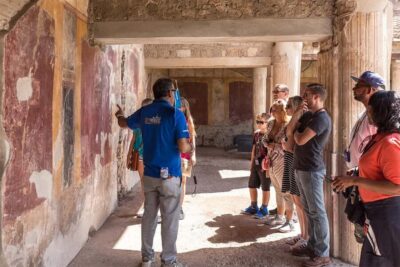
Pompeii is one of those places where the ruins are famous, but the meaning is not automatic. What makes this experience work is that you get skip-the-line admission and archaeologist-led explanations as you move through the city. I love the fast, focused route, and I love the fact that a smaller group means you can actually ask questions instead of just walking and nodding. The main tradeoff is simple: two hours means a lot of ground covered, so you are not going to see every nook at your own pace.
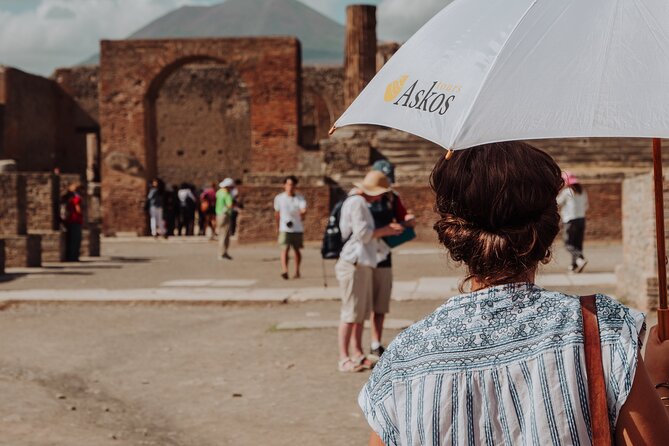
I also like that the tour starts in the right place, Porta Marina Superiore, with an Askos Tours sign at the main entrance. On the guides side, you may meet people like Mario Celentano or Rosanna, and the tone stays practical and clear in English for most visitors. Do plan for the real Pompeii conditions, sun, uneven stone, and crowds that can make hearing a little harder even with headsets.
Key things that make this Pompeii tour a smart pick
- Skip-the-line admission to beat the worst of the queue chaos
- Archaeologist guidance that turns buildings and street layout into something you can picture
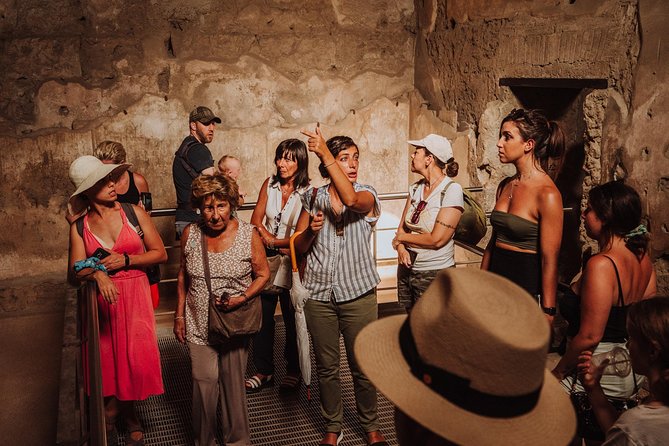
- Small group size (max 20) so questions get answered
- Headsets (for groups of 16 or more) to keep audio clear on a noisy site
- A highlight route in about 2 hours covering the Forum, baths, theaters, and major homes
Pompeii makes more sense when you walk with an archaeologist
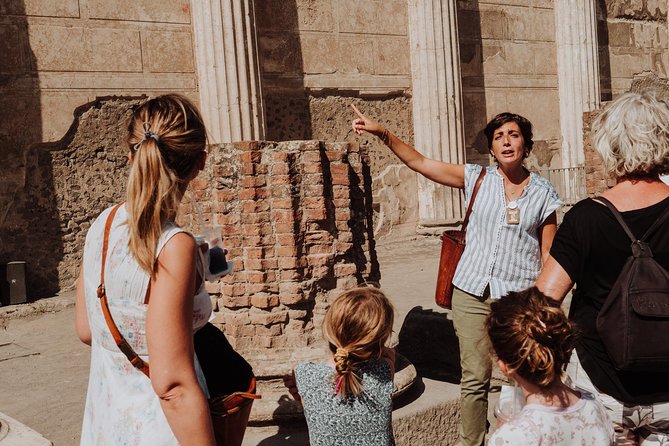
Pompeii is not just a pile of walls. It is a whole living place, with neighborhoods, rules, jobs, and habits that show up in doorways, street widths, and where people gathered. With an archaeologist guide, you stop thinking of the ruins as random scenes, and start seeing cause and effect. Why a street bends here. Why a building was built the way it was. What daily life likely looked like before 79 AD changed everything.
You also get the benefit of a guide who can answer the questions you did not know you had. A typical big crowd tour can feel like a blur. This one is timed, but it is not rushed for the sake of speed. It is built around showing you the Pompeii story from the civic center out to homes and public spaces, then finishing with a couple of standout residences.
If you like your sightseeing with real context, this hits the sweet spot between a self-guided stroll and a slow, private deep lesson. You are still moving, but you leave with mental pictures you can keep.
More of Pompeii:
- Pompeii: Entry Ticket and Guided Tour with an Archaeologist
★ 4.8 · 19,459 reviews - Pompeii: Entry Ticket with Optional Audio Guide
★ 4.2 · 12,360 reviews - From Naples: Pompeii Ruins & Mount Vesuvius Day Tour
★ 4.3 · 11,459 reviews
Price and timing: what your money actually buys
At $35.67 per person for about 2 hours, the price feels reasonable for Pompeii, especially because admission is included and entry is set up to help you avoid the worst lines. For me, that is the value equation. You are not paying just for someone to walk beside you. You are paying for organized access plus expert commentary plus a workable route that covers many major sites.
The tour runs in English and uses a mobile ticket. That matters when you are juggling arrival time, ticket pickup lines, and the constant question of will I have to stand around waiting. If you are traveling on a tight schedule, this type of structure is the difference between seeing Pompeii and just surviving Pompeii.
Group size is capped at 20 people per guide. That cap matters more than it sounds. Headsets help, but the real advantage is that your guide can notice who has questions and who looks lost. In a larger group, you lose that feedback loop, and your brain does not get the answers you need to connect the dots.
Where you meet and how the route starts at Porta Marina Superiore
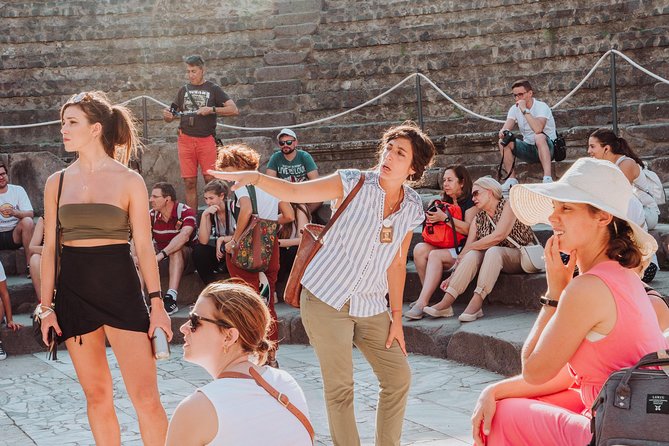
The meeting point is Via Villa dei Misteri, 2, 80045 Pompei NA, Italy. Your guide will be holding an Askos Tours sign at the main entrance of the archaeological site called Porta Marina Superiore. The end is at Piazza Esedra, so after the tour you are positioned well for extra wandering on your own.
This matters because Pompeii is spread out. If you start in the wrong zone or waste time with the wrong entrance, your “2 hour tour” becomes a “stand in line and hurry” tour. Starting at Porta Marina Superiore puts you on a route that hits the Forum area early, then moves through public buildings and homes you are most likely to want to revisit later.
You are also walking on uneven, ancient surfaces. Comfortable shoes are not optional here. I always tell friends to treat Pompeii like a long hike with museums sprinkled inside.
The Forum spine: Foro de Pompeya, Basilica, and the city’s power center
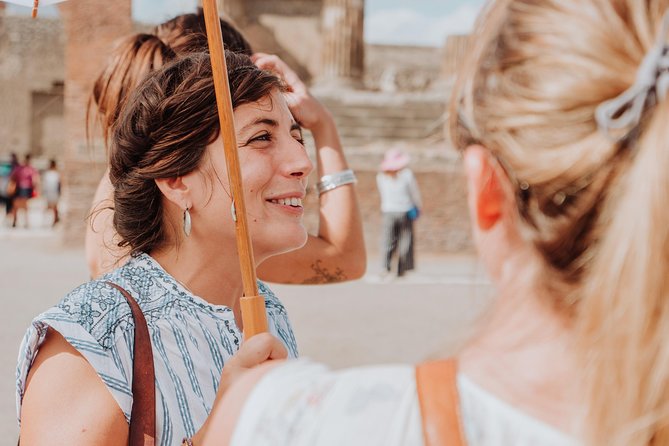
Your route gives you a quick sense of Pompeii’s civic and social heartbeat by starting at the Foro de Pompeya, the main square. This is where people met, where business happened, and where the city felt most public. When you stand in a place like this with a guide, the layout becomes legible. You start to see why certain buildings faced the square and how movement through the area probably worked.
Right after that, you visit the Basilica, described as the courthouse. In Pompeii, a “court house” is more than a legal room. It is a place with daily human traffic, arguments, deals, and the rhythm of people coming and going. A good guide helps you read the space like a scene. You understand what kind of interactions were likely taking place and how public life flowed.
One practical benefit of doing these early, while your brain is fresh, is that they become the anchor points for everything else. Later on, when you see baths, houses, and a theater, you can place them in the bigger picture of how people spent their day.
A different Pompeii day to consider:
- From Rome: Pompeii, Amalfi Coast, and Sorrento Day Trip
★ 4.6 · 7,031 reviews - From Rome: Pompeii, Amalfi Coast and Positano Day Trip
★ 4.6 · 6,620 reviews - Pompeii Small Group Tour with an Archaeologist
★ 5.0 · 6,593 reviews - Pompeii, Amalfi Coast and Positano Day Trip from Rome
★ 4.5 · 6,250 reviews
Lupanar and the Granaries: street life and how a city fed itself
Next comes the Lupanar, the brothel. This is one of those Pompeii stops that people either fear, rush past, or over-romanticize. A guide keeps it grounded. You learn what the setting suggests about sex work as a part of street-level commerce and city life, and you see how these spaces functioned in a broader urban system.
After that, you go to the Granaries of the Forum. This is where Pompeii stops being only about people and starts being about systems. Granaries connect to food supply, trade, and the everyday logistics needed to keep a city running. Even if you are not a history buff, you can feel the relevance: a place like Pompeii cannot function without someone moving grain and managing storage.
If you want a tour that does not treat Pompeii like a theme park, this pairing works. You move from social services to food infrastructure, and you start to understand that the city’s “wow factor” includes very practical building choices.
Houses with stories: House of Menander and the House of the Faun
Pompeii’s houses are where you learn that private life also had structure. In the House of Menander, the key value is how the space helps you imagine household routines and social identity. Your guide can explain what you might be looking at and why it mattered, which is crucial in a city where details can get lost fast if you do not know what to focus on.
Then you move to the House of the Faun, another major residence. This is the kind of house that visually signals status, and it also helps you connect the idea of wealth to actual architecture. You will typically get time for the highlights that matter most, and you are not left guessing where to look or what the space is trying to communicate.
Here’s the realistic part: Pompeii houses can feel like they blend together if you are not guided. With a good archaeologist, you learn the language of Pompeii houses, how courtyards and rooms relate, and what the layout suggests about daily movement inside.
Stabian Baths and the real rhythm of bathing and public spaces
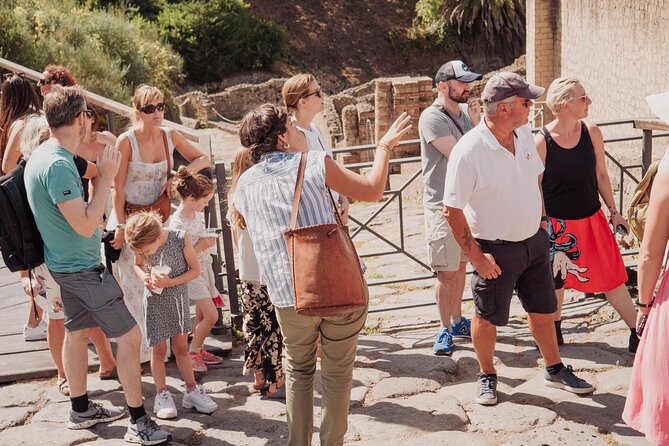
The next step is Stabian Baths, also known as Terme Stabiane. Baths are not just places where people cleaned. They were social hubs, workout spaces, and a daily routine all rolled into one. When you visit the baths with a guide, you get a clearer sense of how warm-cold areas likely worked and why certain rooms existed.
This stop is especially useful if you think Pompeii is all homes and temples. Baths show you a third side of the city, public leisure and physical life.
Because this part of the day includes more walking and sun, it also helps to plan your energy. If you tend to get tired, pace yourself, take a second to drink water, and ask questions while you are standing still. Once you are moving again, it is harder to stop and process.
Via dell’Abbondanza and Thermopolium VI: street food and a city you can picture
You then reach Via dell’Abbondanza, the famous street called out by name in the tour. This is a chance to see Pompeii as a place where people moved, shopped, and ate. Streets matter because they control everything, sight lines, foot traffic, business locations, and how neighborhoods feel.
Right along that “street life” theme is Thermopolium VI. A thermopolium is a type of eatery, and your guide can point out what makes these places distinct. You see how people likely grabbed hot food and drinks quickly, then moved on with their day.
This is one of my favorite types of stops in Pompeii because it connects archaeology to something human. You do not have to be an academic to understand the appeal. You are standing where real meals and daily habits once happened, and the guide’s context helps you imagine the flow of customers and staff.
Teatro Grande and the House of the Vettii finale
You finish the tour area with Teatro Grande, the big theater space. A theater in Pompeii was for more than performances. It helped create shared culture, and it provided a stage for community life. With a guide, you can better understand why the theater would have been a major gathering point and how it fits into the civic spirit you already saw at the Forum.
Then you move to Casa dei Vettii, the House of the Vettii. This is a strong closing stop because it gives you a final look at how elite households decorated and expressed identity. If you have been paying attention, the contrast between public spaces and private life becomes clear.
Ending here also gives you a tidy way to keep exploring after the tour. Since the tour ends at Piazza Esedra, you can decide on the fly whether you want to return to something you loved or continue deeper into the park with your new internal map.
What to expect from the pace, the headsets, and the walking
This tour is about 2 hours and is timed for multiple stops. Many visits are around 10 minutes, with one named street segment included as a free section. That means your guide will hit the essentials at each location. If you want to linger for 30 minutes at one spot, you will need to do that after the tour on your own.
Headsets are included for groups of 16 or more. In practice, that helps a lot in a noisy outdoor site. Still, on the busiest days, you may need to keep your focus on your guide and avoid drifting too far behind. Pompeii crowds can make it hard to hear even with audio.
Finally, plan for the physical side. Uneven stones and slopes are real. Bring water and give your feet the respect they deserve. One good practical tip from past visitors is to carry a water bottle and bring something to beat heat like a hat, and even a small fan can make a long walk easier. Water is available from fountains in the park area, which helps you avoid buying drinks every time you feel thirsty.
Who this Pompeii archaeologist tour suits best
This is a great fit if you:
- Want skip-the-line entry plus an archaeologist guide in English
- Like a compact route that hits major highlights fast
- Enjoy asking questions and getting direct answers
- Prefer a group that stays under 20 people
It is also ideal for families, since the tour format often keeps things moving and makes the ruins easier to understand with narration. If you are the type who likes a plan, this tour gives you one. If you are the type who wants total freedom to wander, you might still enjoy it, then spend extra time after at your favorite stops.
Should you book this Pompeii Explore an Archaeologist tour?
Yes, I think you should book it if your priority is value and clarity. For the cost, you get structured access, an archaeologist guide, admission included, and a route that covers Forum buildings, baths, a theater, major streets, and key houses in about two hours.
Skip this one only if you are looking for a slower, pick-your-own-topics kind of day, or if you feel you need lots of time to get photos at every corner. Pompeii rewards both styles, but a timed group route is not the same as full-day wandering.
If you are visiting Pompeii for the first time, this is a smart way to get the lay of the land, learn what matters, and then choose how you want to spend the rest of your time.
FAQ
How long is the Pompeii Explore an Archaeologist tour?
It is listed at about 2 hours.
What language is the tour offered in?
The tour is offered in English.
Is Pompeii admission included?
Yes. Pompeii admission fee is included, and tickets are handled as a mobile ticket.
What is the maximum group size?
This tour has a maximum of 20 travelers.
Are headsets provided?
Headsets are included for groups of 16 or more.
Where do we meet and where does the tour end?
The start is Via Villa dei Misteri, 2, 80045 Pompei NA, Italy and the end is Piazza Esedra, 80045 Pompei NA, Italy.
Are service animals and dogs allowed?
Service animals are allowed. Dogs are permitted only if they do not exceed 10 kg, and are no more than 40 cm high, and they must be on a leash and held in the arms inside buildings. It is also mandatory to collect their excrement.
What is the cancellation policy for a full refund?
You can cancel for a full refund up to 24 hours in advance of the experience start time. If you cancel less than 24 hours before, the amount paid is not refunded.
Reviewed lately around Pompeii
- From Sorrento: Pompeii Half-Day Skip-the-Line Tour★ 4.6 · 541 reviews
- Day Trip of Pompeii, Herculaneum and Vesuvius from Naples★ 4.5 · 547 reviews
- Pompeii Skip-the-line Tour with Archaeologist Guide★ 5.0 · 559 reviews
- Day Trip of Pompeii, Sorrento and Positano from Naples/Salerno★ 5.0 · 560 reviews
- Pompeii Private Tour with an Archaeologist and Skip The Line – 3 hours★ 5.0 · 564 reviews
- 3 Days in Sorrento, Capri & Pompeii: la Dolce Vita★ 4.0 · 595 reviews
- Sorrento & Pompeii Guided Day Trip from Rome with Optional Pickup★ 4.5 · 598 reviews
- Pompeii private tour with an Official Guide★ 5.0 · 631 reviews
Pompeii Tours, compared.
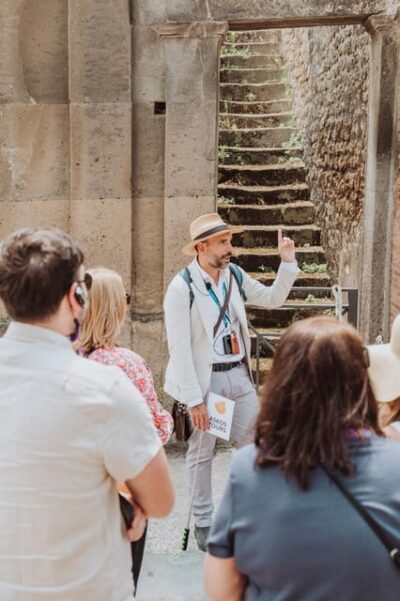
Pompeii: Entry Ticket and Guided Tour with an Archaeologist
Read our review →
Pompeii: Entry Ticket with Optional Audio Guide
Read our review →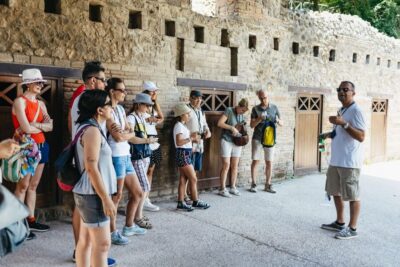


Pompeii Small Group Tour with an Archaeologist
Read our review →
Pompeii, Amalfi Coast and Positano Day Trip from Rome
Read our review →
Pompeii and Mount Vesuvius Day Trip from Rome with Pizza Lunch
Read our review →Browse the lists this tour appears in