
Reviewed · WALKING TOURS
Verona Highlights Walking Tour in Small-group
Verona is one of those cities where the street corners already feel like a history lesson. This small-group walking tour is a smart way to get oriented fast and still hear real context behind what you see. It covers major highlights in about 2 hours, and you can ask questions as you go, which makes the stories stick.
Two things I like: first, the pace is relaxed, so you are not sprinting between stops just to check boxes. Second, the guide connects the big sights, from the medieval fortress-and-bridge setup of Castelvecchio to the Roman engineering of the Arena, in a way that makes Verona feel layered instead of random. Just one caution: there is a fair amount of walking on uneven old streets, and a few parts may be tough if mobility is limited.
If you want an efficient Verona intro that still feels personal, this tour is a strong option. The experience runs rain or shine, and it stays small, with a maximum of 16 travelers, which keeps it conversational.
Key things you will love about this Verona highlights walk
- Piazza Bra as the hub: you start and end in the same central square, easy to plug into the rest of your day
- Arena di Verona context: built in AD 30, tied to the Augustan period, and still used for major opera events
- Castelvecchio plus Scaligero Bridge story: late-medieval power meets the reality of bombing damage and rebuilding
- Juliet and Romeo, but with boundaries: you see Juliet’s House courtyard and Romeo’s place from the outside since it is private
- Scaligeri monuments in quick hits: Arche Scaligere arches for Cangrande I, Mastino II, and Cansignorio
- Forum-to-Dante squares: Piazza delle Erbe (Roman forum roots) and Piazza dei Signori (Dante statue since 1865)
Start in Piazza Bra, then let the city guide your feet
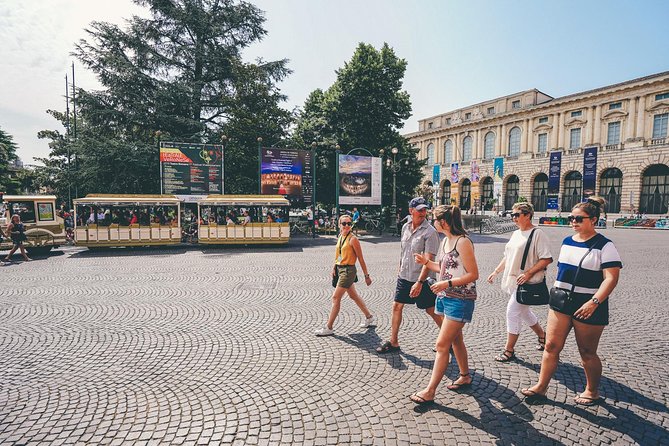
Most Verona trips begin with that same feeling, you step out into the historic center and suddenly everything looks important. This tour starts at Piazza Bra, a wide, café-lined square that also puts you close to the Arena area, so you are not wasting time on logistics.
You also end back at Piazza Bra, which matters more than you might think. When a walking day finishes in the same place you started, you can head for dinner without guessing which way is home base.
The meeting spot is in the open city center and is near public transportation. That means you can treat this like a clean morning or afternoon anchor, then build the rest of Verona around it.
More Walking Tours in Verona
- Verona: History and Hidden Gems Guided Walking Tour
★ 5.0 · 1,379 reviews - Verona: Small Group Guided Walking Tour with Arena Tickets
★ 4.9 · 848 reviews - Verona walking tour:food, wine, legends, lunch/dinner & cable car
★ 5.0 · 386 reviews
Castelvecchio and Scaligero Bridge, war scars and medieval swagger
From Piazza Bra, you swing toward the stretch of Verona that explains the city’s medieval identity. A key stop is Castelvecchio, a medieval castle located right there, which gives you the fortified background behind the streets.
Right after, you cross the Scaligero Bridge, the connection between the castle and the left bank of the Adige. The bridge almost disappeared during bombing, then was rebuilt to look precisely like the original. That detail alone makes the architecture feel less like a postcard and more like a story of survival.
If you like when a guide points out why certain shapes exist, this is where the tour starts delivering. You are seeing the geometry of power, then learning how it was maintained, damaged, and restored.
The Arch of Gavi: a Roman checkpoint you can actually picture

Another quick but meaningful stop is the Arch of Gavi, described as a refined I century AD construction tied to the Roman architect Vitruvio and honoring the gens Gavia, a notable Roman family from Verona.
This is the kind of stop that is easy to miss on your own because it is compact. On the tour, it becomes a bridge between the medieval castle world and the Roman city that came before it.
It also helps you understand how Roman landmarks were not isolated monuments. They were part of a functioning road and city system, so they show up in Verona’s center instead of being out on the edge.
Arena di Verona in context, from AD 30 to opera nights
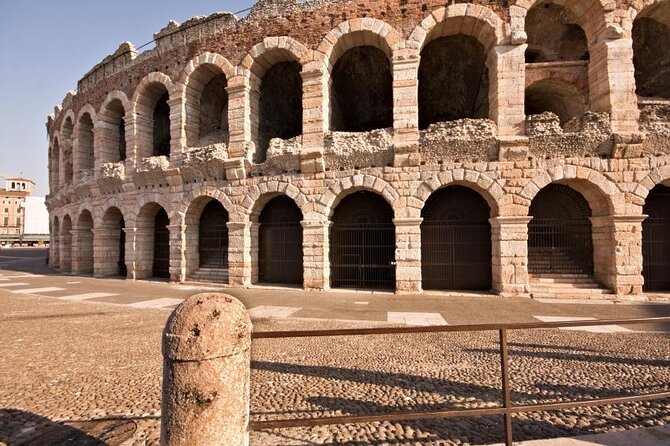
Then comes the big moment, Arena di Verona. You get time to look closely and take photos, and the guide frames it with real numbers and timelines: built by the Romans in the 1st century AD during the Augustan period, and once able to hold up to 30,000 people.
The Arena’s current condition is a big part of why it is so famous. A 2,000-year-old structure that still reads clearly in the landscape makes Verona feel physical in a way museum explanations sometimes cannot.
What I love is the connection to the present. The Arena is not just historical décor, it is still an event space, hosting concerts by international superstars and the Verona Arena Festival, a summer opera celebration drawing classical music lovers from around the world.
Two practical notes:
- Admission for the Arena is not included, so budget for the ticket if you want inside access.
- Plan your time for photos and for the guide’s explanation, because this stop is designed to be the anchor of your “Roman Verona” mental map.
A different Verona day to consider:
- Verona: Hop-on Hop-off Tour 24 or 48-Hour Ticket
★ 4.4 · 2,010 reviews - Verona: Priority Access Arena Guided Tour
★ 4.6 · 1,152 reviews - Verona: Juliet’s House Fast-Track Entry Ticket & Audio Guide
★ 4.2 · 1,121 reviews - Verona: Arena di Verona Opera Ticket
★ 4.6 · 721 reviews
Juliet’s House courtyard, plus the Romeo view you only get from outside
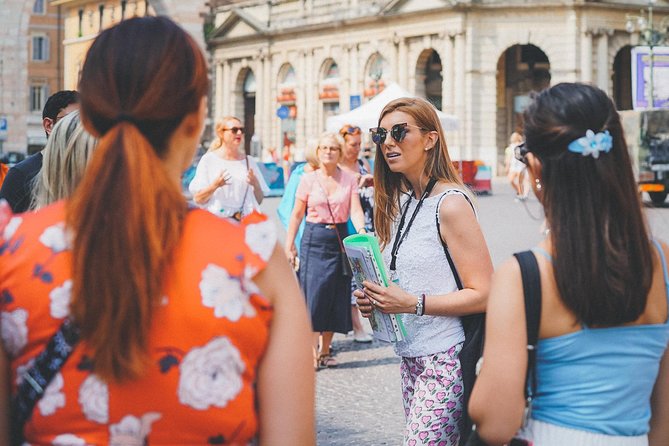
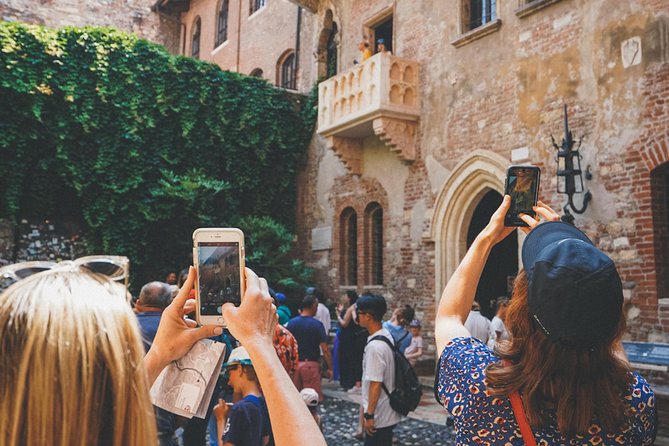
Next you head to Casa di Giulietta. The tour focuses on the famous courtyard connected to the Capuleti home tied to Shakespeare’s Romeo and Juliet. Even if you already know the story, hearing how the site became associated with it gives you better sense of why people swarm here.
There is an important seasonal caveat. From December 6, 2025 to January 6, 2026, the tour does not include access to Juliet’s Balcony as usual, because city administration requires tickets for balcony entry. You can ask the tour team for information on how to purchase, but they will not purchase it for you.
Then you get Romeo’s house. The building is a medieval palace associated with the Montecchi family, but it is private and inhabited, so you only see it from the outside. That can feel limiting, but it is also honest, and it prevents you from walking in expecting something you cannot actually enter.
If you are curious about the legends versus the physical site, this part is where asking questions pays off.
Piazza Bra to Piazza delle Erbe, square by square power shifts
After the Arena and the Shakespeare sites, you spend time in Verona’s open-air living rooms.
First is Piazza Bra, the largest piazza in Verona, lined with cafés and restaurants. It is the perfect breather zone because you can sit, reset your feet, and absorb what you just learned about Verona’s civic and event life.
Then comes Piazza delle Erbe. This one carries Roman weight: it was the forum and center of city life during Roman times. You also learn how the square’s monuments connect to different rulers, with the fountain built during Scaligeri rule being the most famous symbol in the center.
Finally, Piazza dei Signori brings the story into the Renaissance and beyond. This former center of power has a dominant statue of Dante Alighieri since 1865, and the square even earns the nickname Piazza Dante. In just a few minutes, you get a sense of how the city celebrated politics, culture, and big names in stone.
Arche Scaligere: the tomb arches that make the Scaliger story click
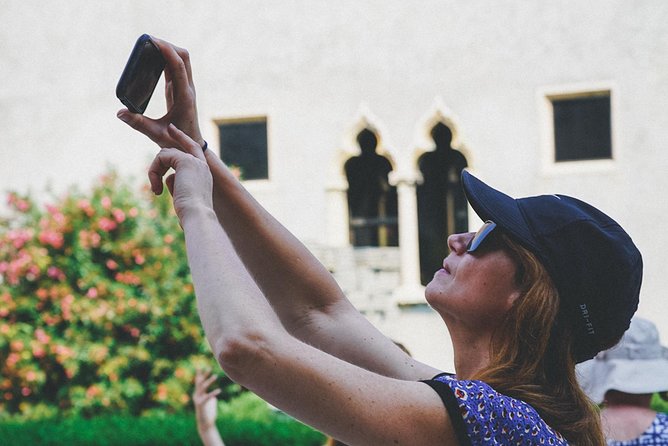
Before you move fully into the open squares, you stop at Arche Scaligere, the Scaligeri cemetery. This is not a long visit, but it is loaded with specific details that give structure to what can otherwise feel like scattered medieval monuments.
You see sarcophagi and, most importantly, the three arches built for Cangrande I, Mastino II, and Cansignorio. When a guide names them clearly, you can look at the arches and feel the hierarchy. It stops being just architecture and becomes family history and political legacy.
Admission for this stop is not included. If you want maximum time inside or behind barriers, you might plan for that extra ticket separately.
Tickets, pricing, and what value actually means here
At $42.33 per person for roughly 2 hours, the price is mostly what you are paying for: a local guide and a structured route that stitches together Roman, medieval, and literary Verona.
The itinerary includes several free stops, including the main squares. But key attractions with entrance fees, like the Arena and Casa di Giulietta (and other sites where admission is not included), are typically ticketed on your own.
One review note that stands out in a practical way: some people liked that the guide helped with timing and line friction at Casa di Giulietta and the Arena. That is not something you should assume blindly, so the best move is to ask what is covered and whether the guide helps with any skip-the-line flow when you book.
If you are the type who would otherwise bounce between sights without context, this tour can be a good value because it saves you from building your own story. If your priority is only seeing one or two attractions with deep time inside, you might decide to do those separately and use a free walking day for the rest.
The small-group advantage, and why the guides matter
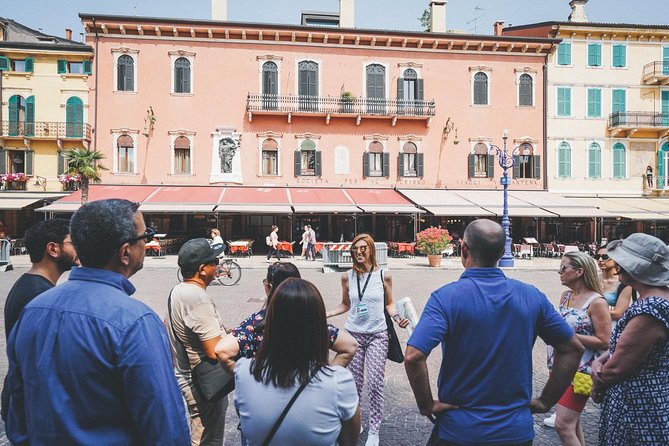
This is capped at 16 travelers, and that size changes the feel. You are not fighting to be heard, and the guide can shape the pace based on questions.
The guide lineup can vary, but I saw repeated praise for guides like Isabella and Frank, and also names including Priscilla, Maria, and Francesco. People frequently mention strong English and a style that balances facts with stories and even humor, which matters on a tour like this, because the topics swing from Roman construction to medieval power to Shakespeare.
Walking pace is a mixed bag depending on the group. The tour is described as relaxed and laidback, but you should still expect steady movement through the historic center. If you want a slow, stop-and-stare photography day, treat this as your orientation hour, then add slower time afterward.
Should you book this Verona Highlights Walking Tour?
Yes, if you want a high-value orientation to Verona that hits the big, recognizable sights in a way that makes them understandable. It is especially good for first-timers because you cover Roman, medieval, and literary Verona in a single block of time, starting and ending in Piazza Bra.
Book it if:
- You like getting the why behind what you see, not just the what
- You want a small-group format and a guide you can ask questions to
- You plan to visit the Arena and Casa di Giulietta with proper admission
Skip it or rethink if:
- You have limited walking tolerance and need frequent pauses with minimal movement
- You only care about one paid attraction and would rather spend more time elsewhere on your own
- You travel in a window where Juliet’s Balcony access is restricted and you specifically want balcony entry, since that part may require a separate ticket from December 6, 2025 to January 6, 2026
If you are coming for atmosphere, architecture, and a sense of Verona’s timeline, this is a very efficient way to start.
FAQ
How long is the Verona highlights walking tour?
It runs for about 2 hours.
What is the price per person?
The price is $42.33 per person.
Where does the tour start and end?
The tour starts and ends at Piazza Bra in Verona.
Is the tour in English?
Yes, it is offered in English.
What is included in the tour price?
The tour includes a local tour guide and a mobile ticket.
Are entrance tickets included for the major sights?
No. Admission tickets are not included for key sights like the Arena and Casa di Giulietta (and some other stops). The squares are free.
Does the tour run in bad weather?
Yes, it runs rain or shine.
Is there a group size limit?
Yes. The tour has a maximum of 16 travelers.
Is Juliet’s Balcony access included during December 6, 2025 to January 6, 2026?
No. During that period, the tour does not include access to Juliet’s Balcony as usual, and balcony entry requires a ticket purchased through city administration.
Can I get a full refund if I cancel?
Yes. You can cancel up to 24 hours in advance for a full refund.
Reviewed lately around Verona
- Verona: Pasta and Tiramisu Cooking Class With Free Flowing Wine★ 5.0 · 575 reviews
- Verona: Pasta and Tiramisu Cooking Class with Fine Wine★ 4.8 · 633 reviews
- Verona: Juliet’s House Fast-Track Entry Ticket & Audio Guide★ 4.2 · 1,121 reviews
- Verona: Priority Access Arena Guided Tour★ 4.6 · 1,152 reviews
- Verona: Hop-on Hop-off Tour 24 or 48-Hour Ticket★ 4.4 · 2,010 reviews
- Verona walking tour:food, wine, legends, lunch/dinner & cable car★ 5.0 · 386 reviews
- Verona: Small Group Guided Walking Tour with Arena Tickets★ 4.9 · 848 reviews
- Verona: History and Hidden Gems Guided Walking Tour★ 5.0 · 1,379 reviews
Walking Tours, compared.
Guided Walking Tour & Last Supper Visit with Ticket
Read our review →
Rialto Bridge & Offbeat Unusual Venice Walking Tour
Read our review →
Private 3 hrs Venice Tour: St Mark’s, Walking tour & Boat tour
Read our review →
Skip the line: Uffizi and Accademia Small Group Walking Tour
Read our review →Browse the lists this tour appears in