Reviewed · PRIVATE
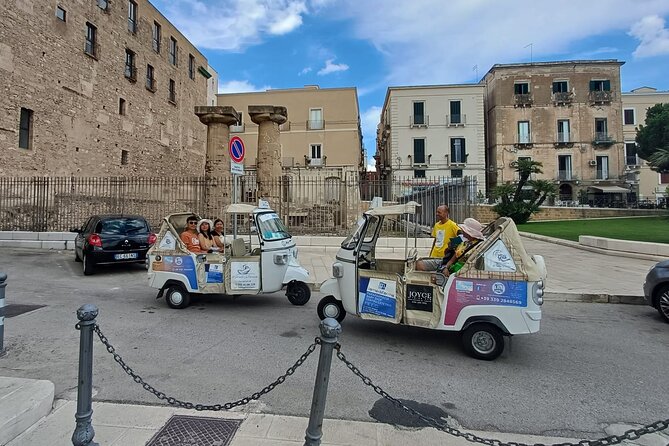
Private Tour of Taranto aboard an Ape Calessino
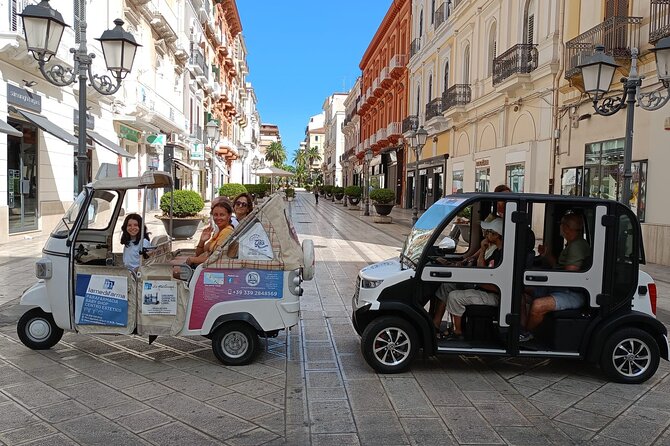
Taranto can be a little tricky to explore well on your own, and that is exactly why this Ape Calessino tour feels so smart. I love the quick-hit views over Mare Piccolo and the way you end at the ancient Tempio di Poseidon without wasting time. One drawback to plan for: you are moving fast through a lot of highlights, so if you want long museum time or deep, slow wandering, this is not that kind of tour.
This is a private tour for your group only, guided in English, and it runs about 50 minutes. In my experience, the highlights are the point, and the guides really do steer you toward the best angles for photos, plus the stories that make the streets feel meaningful.
Key highlights at a glance
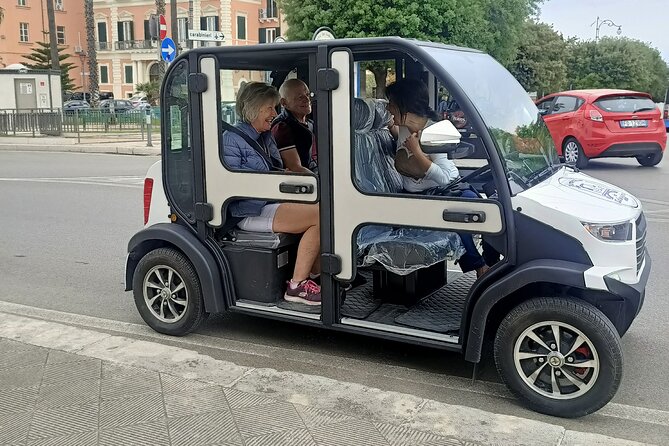
- Ape Calessino access: you can reach areas normal cars struggle with, including narrower lanes near the old town
- Mare Piccolo viewpoints: see the gulf scenario with bridges, springs, and the working water culture tied to fishing and mussels
- Ancient Greece closer than you expect: the Tempio di Poseidon is part of the finish, not a separate detour
- Churches tied to local life: from San Domenico Maggiore and its Easter-linked tradition to San Cataldo Cathedral
- Fast stops with no ticket hassle: major viewpoints and sights here are listed as free admission
- English-guided, private, and about an hour: ideal if you are on a tight schedule, like a port stop
Why the Ape Calessino Works in Taranto’s Tight Old Streets
Taranto is a port city with layers, old town turns, and hills. On foot, you can end up zig-zagging more than sightseeing. In the Ape Calessino, you get the best of both worlds: you still see the city’s big moments, but you are not worn out before you reach them.
The real value is how the tour compresses geography into something doable. You start near Piazza Castello, then you rotate through key neighborhoods that shift from views and waterfront to hill climbs and back down again. That kind of routing is hard to pull off alone in a short window.
Also, it is private. So if you want to spend an extra minute near a fountain or ask one more question about a bridge, you can. That is a big difference from a group bus where you are always watching the clock.
More Taranto bookings worth a look
- From Milan: Como & Bellagio with Private Lake Como Cruise
★ 4.6 · 9,788 reviews - Murano & Burano Islands Guided Small-Group Tour by Private Boat
★ 4.5 · 7,580 reviews
Getting Started at Piazza Castello, Then Switching From Castle Views to Sea Views
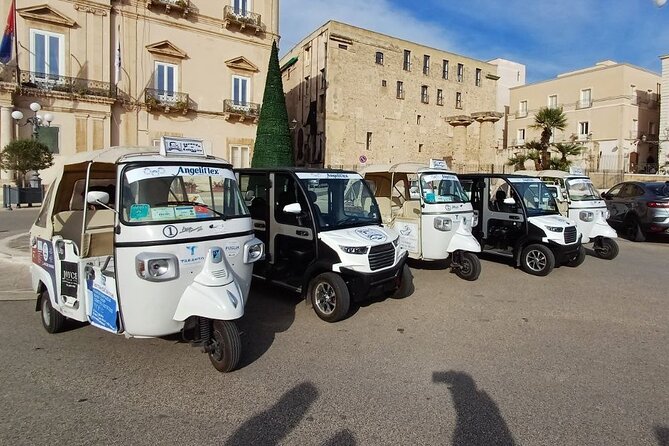
Your tour begins at Piazza Castello (P.za Castello, 74123 Taranto). The schedule is broad, with operations running daily from 9:00 AM to 8:00 PM, so you can usually pick a time that matches your day.
Right away, you are oriented to the city. There is also a practical twist: the castle area takes about an hour to properly visit, so instead of trying to cram it in, the guide gives you a description with an outside view. That is actually smart. You get the context without turning the tour into a long museum day.
From there, you pivot toward the promenade and open viewpoints. One stop is essentially about the big picture: along the promenade, you get descriptions of monuments without forced, time-consuming detours. If you have ever walked a seaside stretch and thought, I know I am passing something, but I cannot figure out what it is, you will appreciate this approach.
Rotonda del Lungomare to Piazza Ebalia: Fascist-Era Buildings and the Compass Rose Fountain
A quick early win is how the guide threads different time periods through the same route. Near the Rotonda del Lungomare, you pause briefly at Palazzo del Governo and the nearby Central Post Office. This is your snapshot of fascist-period architecture, explained in a way that connects the building style to the era that shaped it.
Then you roll toward Piazza Ebalia, where you stop for another short, high-value moment. Here the star is the fountain of the Compass Rose, plus a look at the Bank of Italy building. Even if you are not an architecture person, fountains and civic buildings help you understand how a working port city organizes attention, money, and movement.
These are listed as free-admission stops, and that matters. When you only have about 50 minutes, you want your time to go to what you can actually see, not to buying tickets or figuring out entry lines.
Old Town Passes: MarTa, the Swing Bridge, and the Canal Story
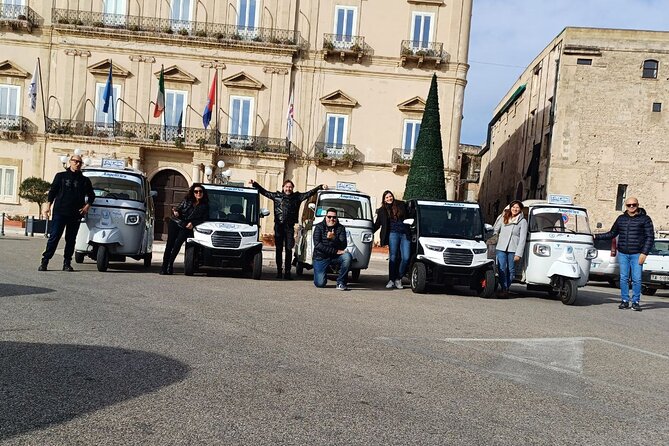
Not every moment is a formal stop where you get out and walk. Some segments are done as slow passes that let you absorb the old town fabric while the guide talks.
As you return to the old city, you pass in front of the National Archaeological Museum (MarTa). You do not have to commit to the museum during this tour, but seeing it from the street is useful. It signals that Taranto’s story is not only seaside romance, it is archaeology and Magna Graecia too.
A standout piece here is the swing bridge and the navigable canal. The guide explains the way the canal and its infrastructure were transformed in the late 1800s. You will likely start seeing the city differently after this. The bridges and canal do not feel random. They feel like the practical skeleton of a port that evolved to keep trade and movement flowing.
If you are the type who likes understanding how cities work, this section is a quiet win.
Mare Piccolo at the Vasto Descent: Arsenal, Bridges, Springs, and Mussel Farms

This is where Taranto becomes unforgettable. The tour stops at Mare Piccolo at the end of the descent of the Vasto, and the guide sets the scene so you can actually read what you are seeing.
You look across toward the military Arsenal, then take in the Punta Penna Pizzone bridge, plus the first and second “breasts” of the Mar Piccolo. It is helpful that the guide does not just point. It tells you what each part is for, and how the coastline is shaped by water, access, and defense.
One of my favorite kinds of tour facts is when you learn what you can taste or buy locally. Here, you hear about the springs of fresh water called Citri, and how they connect to fishing and mussel cultivation. It is the kind of detail that makes a sea view feel grounded in daily life rather than postcard scenery.
This stop is about admiration, not a long walk. It is listed as a 5-minute stop with free admission, and that pacing is perfect for most people. You get your photo moment, then you move on without losing the tour’s momentum.
Piazza Fontana to San Domenico Maggiore: Where People Still Feel the Easter Stories
After the sea viewpoint, you cross the street network that brings you into the marina area and toward Piazza Fontana. Here you get a brief stop to see the fountain restored in the 1980s by Carrino, plus the 18th-century clock tower. Clock towers are one of those “small” things that suddenly feel important once someone explains why they mattered in city life.
Then it is up the San Domenico slope to San Domenico Maggiore Church, a church from the 1300s. The guide connects the building to local tradition, specifically the procession of the sacred mysteries that precedes Easter, an event deeply felt by Taranto’s people.
That is a great example of why the tour works even though it is short. If you are only skimming sights, the church might be just another impressive facade. With the story tied to Easter, you can see it as a living part of the town’s calendar.
The stop is listed at about 7 minutes, free admission. That is long enough for you to take in the space, but not long enough to replace a full church visit on a separate day. Use it as an introduction, not a destination.
Cattedrale Duomo di San Cataldo: Patron Saint, Irish Origins, and a Real Sense of Place
Next is Cattedrale Duomo di San Cataldo, described as the oldest cathedral in Puglia. The big hook is San Cataldo: of Irish origins, the patron saint of Taranto, and also the bishop of the city.
This stop is longer than the quick fountains, at about 10 minutes. You walk along via Duomo to reach the cathedral, so it also gives you a short transition from one hill experience into another “center” feeling.
What I like here is how the guide uses one person’s background to connect history, religion, and identity. San Cataldo’s story is not only a name on a plaque. It becomes a reason why the cathedral matters to the city.
If you are sensitive to how crowded churches can get, 10 minutes is a comfortable rhythm. You get a meaningful look without feeling trapped.
Tempio di Poseidon Finish at Piazza Municipio
The finish is the Tempio di Poseidon, a Doric temple dating to the sixth century BC. The guide frames it as the only surviving testimony from the Magna Graecia era, which gives this stop extra weight. It is not a random ruin. It is the anchor that pulls the ancient Greek side of Taranto into view.
You reach it in Piazza Municipio, right in front of the point where their Falanto tour started. That detail matters because it helps you plan your next move. After the tour ends back at the meeting point near Piazza Castello, you will likely want to keep exploring, and finishing near a central reference point makes that easier.
This is also a strong “wrap up” moment. You have moved from seaside to hills to major churches, and then the tour lands back in the ancient story that started all of it.
Price and Value: What $24.20 Buys You in Real Sightseeing Time
At about $24.20 per person and roughly 50 minutes, this is priced like a smart introduction tour, not a full-day program. For value, I look at three things: how many major areas you cover, whether the vehicle helps you reach places, and whether you skip friction like ticket lines.
Here you do all three. You cover seaside viewpoints (Mare Piccolo), major urban landmarks (palaces and civic spaces like Piazza Ebalia and Piazza Fontana), and two big church stops, plus the ancient temple finish.
That is a lot of “first look at Taranto” for under an hour. It is also private, which usually makes per-person cost higher. This price point is why it works so well for tight schedules and port days.
Still, be honest with yourself about expectations. One short tour cannot replace a museum day, a long waterfront walk, or a separate church visit. If you want depth, you should plan a second day or a longer afternoon after you get your bearings.
Tips for Hearing Your Guide and Making the Most of the Stops
One practical point comes up: because you are sitting behind the guide in the Ape Calessino, you might have to strain a bit if the vehicle is moving or if traffic is loud. I recommend bringing your attention habits with you. Ask questions right after a stop, not while the cart is cruising.
Also, one person noted the Ape Calessino needed maintenance and seat belts needed attention. I cannot verify the condition of your specific vehicle, but you can do two quick checks before you roll. Make sure you can fasten the seat belt comfortably, and that everything feels secure.
For photos, focus on your priorities. The best guaranteed photo moment is the Mare Piccolo stop at the Vasto descent. Plan your questions for churches right before you arrive, so you are not asking while you are trying to frame a shot.
Finally, if you are on a rainy day or low-activity day, short guided tours like this can be a relief. You stay in motion, you see the key sights, and you do not spend half your time navigating.
Should You Book This Private Taranto Tuk Tuk Tour?
Book it if you want the fastest, most structured way to see Taranto’s highlights, especially if you have less than a full day. It is great for first-timers because it gives you a guided path through the old city, sea viewpoints, major churches, and the ancient Tempio di Poseidon without wasting time.
Skip it or pair it carefully if your idea of a vacation is long, slow exploration. Taranto is not trying to be a theme-park of museums, and a short ride means you will be introduced to more than you can fully absorb.
If you do book, consider noting your top two targets ahead of time, for example Mare Piccolo and the Duomo di San Cataldo. Then ask your guide, in English, to point out the exact details you care about. Guides like Sara, Francesco, Roberto, Luigi, Andrea, Rosella, and Florina have shown up in past groups, and that kind of local storytelling is what makes the hour feel worthwhile.
FAQ
How long is the Private Tour of Taranto aboard an Ape Calessino?
It runs for about 50 minutes.
Where does the tour start and end?
The tour starts at Piazza Castello (P.za Castello, 74123 Taranto TA, Italy) and ends back at the meeting point.
Is the tour private and only for my group?
Yes, it is a private tour/activity, so only your group participates.
What language is the tour offered in?
The tour is offered in English.
Do I need to buy admission tickets for the stops?
Admission is listed as free for the stops noted in the tour plan.
Are mobile tickets used?
Yes, you receive a mobile ticket.
Can I visit this tour if the weather is poor?
This experience requires good weather. If it is canceled due to poor weather, you will be offered a different date or a full refund.
Is there free cancellation?
Yes, cancellation is free if you cancel up to 24 hours in advance for a full refund.
Reviewed lately around Taranto
- Puglia Cooking class “Le orecchiette, che pasta!”★ 5.0 · 249 reviews
- Mozzarella Experience – Cheese Tour and tastings to Masseria Fragnite★ 5.0 · 266 reviews
Private, compared.
Como & Bellagio with Private Lake Como Cruise
Read our review →
Murano & Burano Islands Guided Small-Group Tour by Private Boat
Read our review →
Rome by Golf Cart Private Tour: Beyond the Landmarks
Read our review →
Early Morning Vatican, Sistine, St. Peter’s Semi or Private Tour
Read our review →
Private 3 hrs Venice Tour: St Mark’s, Walking tour & Boat tour
Read our review →
Private Gondola Cruise for up to 5 Passengers
Read our review →