
Reviewed · FIAT 500 TOURS
Rome: The Original Fiat 500 Self-Drive Tour
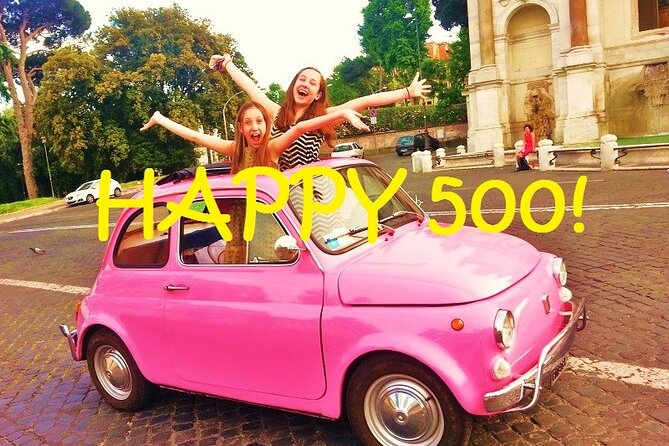
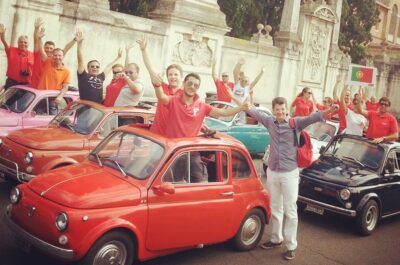
This is a fun way to see Rome, because you are not just walking past the landmarks. You ride and drive in a candy-colored Fiat 500 Cinquecento, with the vibe of an old-school Italian road trip and your guide steering you through quieter streets. I love the way the group gets set up for confidence fast, and you spend real time behind the wheel instead of just sitting in a van.
I also like the mix of big-name sights and perspective-changing viewpoints. You will connect dots between places like Circus Maximus and the Colosseum area, then go for the more unusual views such as Buco della Serratura and the Aventine keyhole stops. That blend means you come away with both iconic Rome and the moments that feel like you found them on your own.
One possible drawback to plan for: the Fiat 500 is manual, so you need stick-shift comfort to enjoy it. Also, the cars are small, so if you are tall or larger-framed, you will want to double-check the fit limits before booking.
Key Things to Know Before You Start
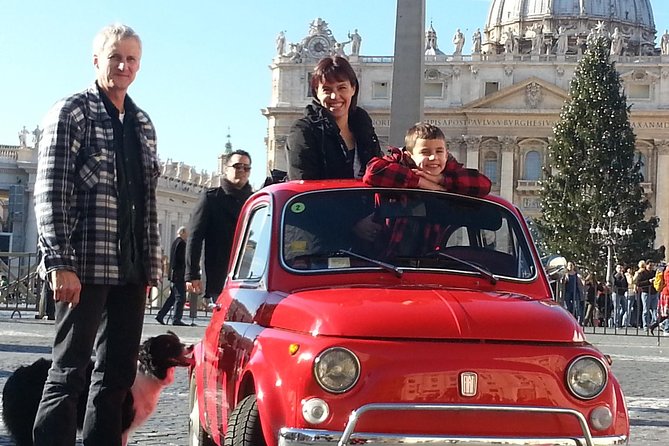
- Small group feel with a limit of 10 people, usually split into separate Fiats so you are not packed in
- Manual car, soft-top fun plus a quick safety briefing before you hit the streets
- Photo-forward timing at each stop, including free photo shooting with your own phone or camera
- A route built for narrow streets, where bigger vehicles cannot go comfortably
- Offbeat Rome moments like keyhole views, the hill of broken vases, and Trastevere lanes
- Included espresso or cappuccino to keep energy steady during the 3 hour loop
Driving Rome Like a Local in a Candy-Colored Fiat 500
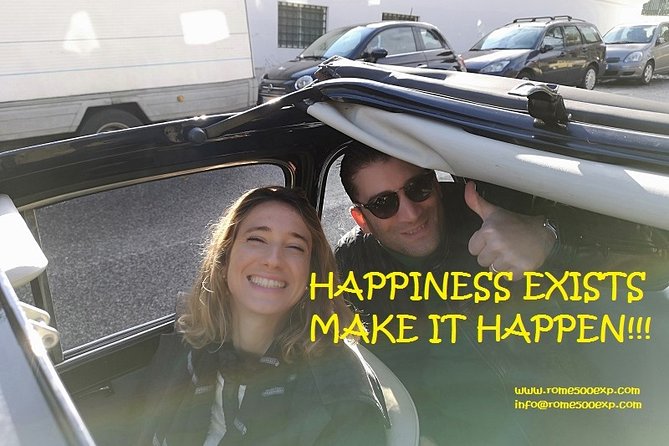
This tour is interesting because Rome changes when you view it from a tiny car. The Fiat 500 forces you to slow down, pay attention, and follow the street rhythm, instead of rushing from sidewalk to sidewalk. The soft-top setup also helps, since you get sun and air while you cruise.
I like that this is not just about checking boxes. Your guide builds a path through quieter roads and narrower areas, the kind of streets where you can actually picture how Romans travel day to day. And because the cars are so photogenic, you will often get the reaction factor, people waving and taking pictures as you roll by.
The vibe is also practical. You get a short safety briefing first, then you start with your guide leading the way. That helps if you are nervous about driving in busy Rome, because you are not figuring it out alone.
More Fiat 500 Tours in Rome:
- Vintage Fiat 500 Cabriolet: Rome’s Highlight Semi Private Tour
★ 5.0 · 283 reviews - Rome Driving Tour By Vintage Fiat 500
★ 4.9 · 224 reviews - Self-Drive Vintage Fiat 500 Tour from Florence: Tuscan Hills and Italian Cuisine
★ 5.0 · 719 reviews
Your Cinquecento Setup: Manual Controls, Car Comfort, and Fit Limits
Before you go anywhere, you will get a rundown of the Fiat 500 manual controls and how to handle the clutch and stick shift. This matters. If you have never driven manual, the first minutes can feel intense, especially on tighter turns and slow traffic.
Also keep the car size in mind. The tour allows a maximum of three adults per Fiat, or two adults and two children, so the seating is tight. There are explicit limits for comfort and safety, including not suitable for passengers over 220 pounds (100 kg) or taller than 6.2 feet (1.9 meters). If you fall outside those ranges, you should not assume it will be fine.
Finally, plan your footwear. You are asked to wear closed-toe shoes only, no sandals or flip flops. It sounds minor until you realize you will be shifting and moving your legs around a very small cabin.
The Route Strategy: How You Get Highlights Plus Side Roads
The best part of the format is that it is a self-drive style tour, but you are not left on your own. Your guide follows along in the lead car and keeps the group together. In practical terms, this means you can enjoy the driving while still knowing where you are going and when you will pause.
You will pass major landmarks from the road as you go, including places like the Colosseum area, the Arch of Constantine zone, and the Mouth of Truth area. Then you switch gears into smaller stop points that are easy to miss if you only follow big-tour routes.
What makes the route feel smart is the pacing. Stops are short and timed for photos and quick orientation, so you do not waste half your afternoon standing around. Expect photo moments plus guide stories, then you roll on.
Terme di Caracalla: Ancient Rome’s Huge Bath City
Your first major stop is Terme di Caracalla, with about 10 minutes on site. The ruins are massive. This was one of the biggest and most sophisticated ancient Roman bath complexes, and the scale is hard to ignore once you are standing there.
What you will enjoy here is the visual size. The space was big enough to feel like a full campus, not just a building. The site also included more than baths, with libraries, gyms, theaters, seminar rooms, gardens, and fountains. That means the ruins read like a whole health and culture center, not only a place to wash.
Practical note: since the stop is brief, you will get more out of this if you look up at the structure and sweep your eyes around rather than trying to read every stone. Wear shoes with solid grip, because ruins can be uneven underfoot.
More from a Rome stay:
- Colosseum, Roman Forum & Palatine Guided Tour
★ 4.7 · 63,148 reviews - Vatican Museums, Sistine Chapel & St Peter’s Basilica Guided Tour
★ 4.5 · 39,149 reviews - Rome: Colosseum, Palatine Hill and Roman Forum Guided Tour
★ 4.8 · 32,814 reviews - Rome: Guided Tour of Colosseum, Roman Forum & Palatine Hill
★ 4.7 · 27,897 reviews
Buco della Serratura and Parco Savello: The Keyhole View You Came for
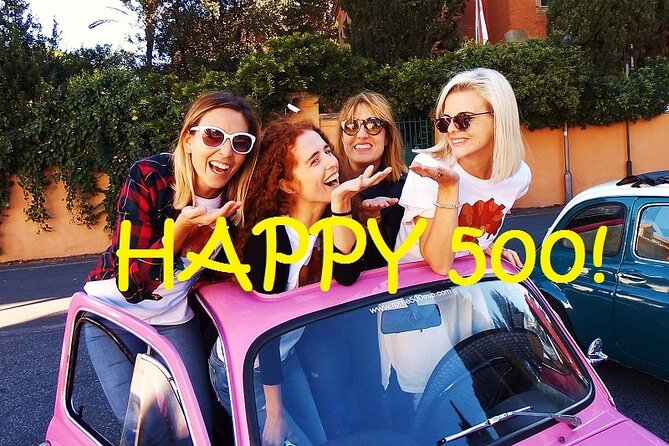
Two of the stops focus on one of Rome’s most famous visual tricks: keyhole views. You will spend around 20 minutes at Buco della Serratura, and then another keyhole viewpoint in the Parco Savello area.
The big wow factor is simple. Looking through the keyhole creates a line-up where you can see three countries in line. It is also a great place to get photos aboard the Fiat 500, since the tour plan is built around letting you frame a shot without rushing.
What to watch for: the keyhole is a literal focal point. So instead of trying to photograph the whole scene, aim for your best angle and then shoot a second time from a slightly different height or zoom setting. Short stop time means you will be thankful you planned your shot quickly.
Circus Maximus: Echoes, Scale, and Race-Day Energy
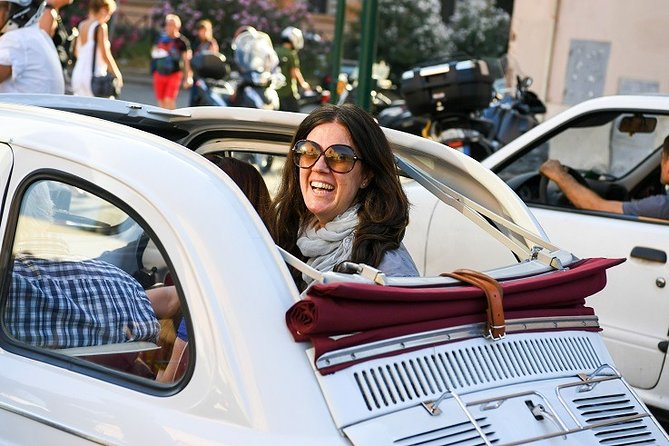
At Circo Massimo, you get about 20 minutes. This is one of those places where Rome feels loud even when it is quiet, because the memory of the ancient races lingers in your imagination.
The tour framing here helps. Circus Maximus is described as built centuries before the Colosseum and as the giant arena where Roman crowds packed in for fast, dramatic chariot racing. You can also see how it connects to modern Rome, since the space is sometimes used for rock concerts.
My advice for this stop: keep it simple. Find a spot where you can picture the track shape and crowd size, then let the guide’s context do the heavy lifting. Because it is a stop built for short listening plus photo time, you do not need to over-study.
Piazzale Giuseppe Garibaldi: Janiculum Terrace for the Best Angle
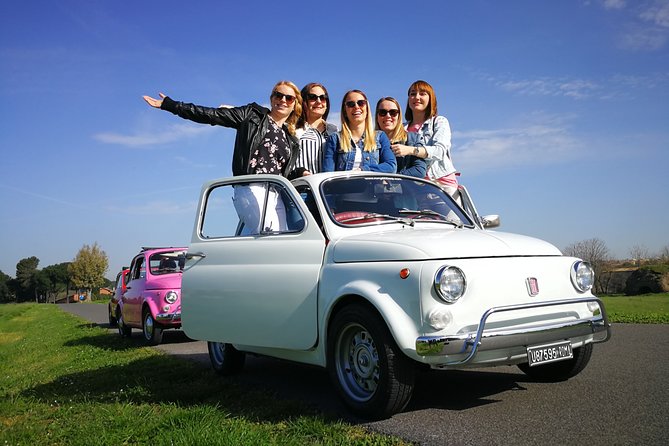
Next up is Piazzale Giuseppe Garibaldi, the Janiculum terrace area, with about 20 minutes. This is a panorama stop. From here, you can take in major sights at once, including the Colosseum, Pantheon, Altare della Patria, and many of the domes that define Rome’s skyline.
The reason this stop works well in a driving tour is timing. You reach the viewpoint after you have already seen a lot of Rome’s stone and street texture from street level, so the vista feels like a payoff. It also gives your eyes a break from narrow roads.
Practical tip: bring your camera ready before you park. Panoramas are quick, and it is easy to lose two minutes while you fiddle with settings.
Porta San Paolo and the Pyramid-Like Tomb of Gaius Cestius
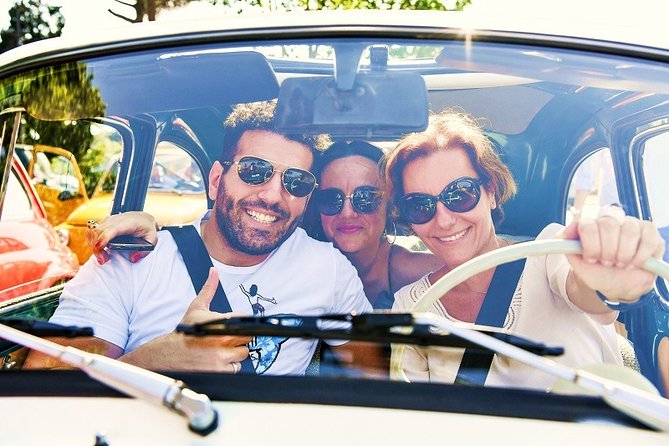
At Porta San Paolo, you spend about 20 minutes. The highlight is a pyramid-like structure in Rome, described as the fourth biggest Egyptian pyramid on Italian soil, built around 18 BCE.
This is not just a strange trivia moment. The structure is linked to the tomb of Gaius Cestius, a wealthy and eccentric Roman. That backstory gives the stop meaning, because you start to see how Rome borrowed styles and materials to project power and memory.
The drawback here is mainly your expectations. It is not an enormous museum stop with guided rooms. It is a short, exterior-oriented pause where the guide’s explanation makes the difference.
Via Galvani and Monte Testaccio: The Hill Made from Broken Pots
Then you head to Via Galvani, focused on the hill of broken vases. This is about 20 minutes and it is one of the most quietly fascinating stops on the whole loop.
Here is what makes it unusual: the Romans created an artificial hill using fragments of terracotta vessels used to transport olive oil, fish sauce, and wine. Over time, what started as a dump became a full hill, estimated around 40 meters high with roughly 700 meters in circumference. The scale estimate includes terracottas from about 50 million vases.
Why you will like it, even if you are not a hardcore ruins person: it reads like a real-world system. Rome was not only monuments and temples, it was logistics, supply, and daily life. This hill is a footprint of that daily life.
Trastevere Lanes and Porta San Sebastiano: A More Local Ending
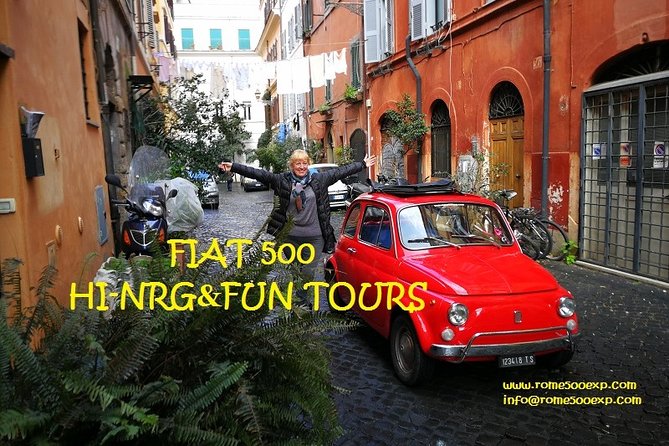
For the finale mood, you drive into Trastevere, with about 20 minutes. This is the part where the tiny Fiat 500 payoff really hits. You whiz through narrow lanes where bigger cars would struggle, and you get those street-level views that feel more like neighborhood life than postcard Rome.
The tour also includes Porta San Sebastiano for another about 20 minutes. That adds a strong historical bookend, since this is another ancient boundary area that fits the day’s theme of Rome from the road.
If you want photos, time your shots around traffic flow. Narrow streets fill up quickly, and your guide will help coordinate the moment when it is easiest to pull focus on your camera.
Stops for Espresso and Photo Time on Your Phone
You will get a coffee stop built into the experience: one espresso or cappuccino per participant is included. This is exactly the kind of included perk that makes a short tour feel smoother. It is not a huge meal, but it keeps energy up between stops.
During the tour, there is also a point where you can get gelato or coffee on your own before you finish. So I suggest budgeting a little extra for personal snacks, especially if you are the kind of person who always needs one sweet stop in Italy.
The other helpful inclusion is free photo shooting using your own cellphone or camera. The tour team is used to taking good angles quickly, which is great when you only have 10 to 20 minutes at each location.
Price and Value: What $211.72 Really Buys You
At $211.72 per person for about 3 hours, this is not the cheapest way to see Rome. The value comes from three things you cannot easily replicate on your own.
First, you get the car. A vintage Fiat 500 is the center of the experience, and it is not just a prop. You actually drive it, which turns sightseeing into an activity.
Second, you get a route that uses small streets. The tour plan aims at roads that are often inaccessible or impractical for bigger vehicles. That saves your energy, since you do not have to plan a complicated self-drive route through tight areas.
Third, you get guide context in short bursts. The stops are timed so you can listen, take photos, and then keep moving. If you like learning, this structure keeps the day fun instead of turning it into a lecture.
Add in the included espresso or cappuccino and the free phone photo help, and it starts to feel like you are paying for the full package: driving, timing, and interpretation.
Manual Driving Reality Check: Who Should Book, and Who Should Skip
This tour is best if you can handle a manual transmission. The guide will brief you, and the driving pace is managed so you can keep up, but the car is still a stick shift. You should only book this if you are comfortable enough to steer and shift smoothly.
It is also a better fit for people who enjoy short stops and active sightseeing. The tour is built around 10 to 20 minute windows, not long museum wandering.
If you worry about fitting in the car, check the stated limits and do not try to “hope for the best.” Small cars feel cute until you need extra leg space.
Planning Tips That Make the Day Easier
Here are a few practical things that can make or break your enjoyment.
Arrive early and confirm you are at Palazzo Manfredi, Via Labicana 125. The meeting point is central, but city traffic and walking add up. If you are running late, you may lose time before the briefing.
Bring a plan for your phone. You will be taking pictures in quick bursts. If you have a phone strap or camera setup, use it so you can move fast when the stop moment hits.
Finally, keep expectations flexible about insurance. One common issue that can pop up is optional extra insurance coverage requested right before starting. That does not mean the tour is unsafe, but it does mean you should be ready with a payment method if they offer the upgrade.
Should You Book This Rome Original Fiat 500 Self-Drive Tour?
Book it if you want an original, street-level way to see Rome that feels like Italy, not an airport transfer between sights. If you like classic cars, photo stops, and short guide stories timed to your route, this is a strong fit.
Skip it if you cannot drive a manual car and you think you will be stressed the whole time. Also skip if the Fiat 500 size limits would make you uncomfortable. In those cases, you will spend the day focused on fit and driving tension instead of enjoying the sights.
If manual driving is your thing and you want a small-group experience that mixes major Roman landmarks with quirky viewpoints like keyhole scenes and the hill of broken vases, this is one of the most memorable ways to spend 3 hours in Rome.
FAQ
How long is the Fiat 500 self-drive tour?
The tour lasts about 3 hours.
How much does the tour cost?
The price is $211.72 per person.
Is the tour in English?
Yes, the tour is offered in English.
Where does the tour start and end?
It starts at Palazzo Manfredi, Via Labicana 125, 00184 Roma RM, Italy, and ends back at the same meeting point.
Do I get hotel pickup?
No, hotel pickup and drop-off are not included.
Do the Fiat 500 cars have automatic transmission?
No. The cars have manual stick/clutch, not automatic.
What do I need to drive the car?
You must be at least 18 to drive, and you need a valid European Union driving license or an International Driving Permit. The driver also needs sufficient experience with manual transmission.
What is included in the price?
A professional guide, use of a vintage Fiat 500, and coffee or tea (one espresso or cappuccino per participant) are included. There is also free photo shooting with your cellphone or camera.
Can I cancel for a full refund?
Yes. You can cancel up to 24 hours in advance for a full refund.
Reviewed lately around Rome
- Rome: Private Customizable 3-Hour Golf Cart City Tour★ 5.0 · 229 reviews
- Papal Audience Experience with Pope Leo XIV★ 4.5 · 230 reviews
- The Three Tenors in Rome – Nessun Dorma★ 4.5 · 231 reviews
- Discover Rome in a Day – Private Driver Tour★ 5.0 · 231 reviews
- Rome: Colosseum, Roman Forum & Palatine Hill Group Tour★ 4.7 · 232 reviews
- Rome Airport Transfer – Private Luxury Service with Driver★ 4.5 · 231 reviews
- Fast track: Vatican Museums, Sistine Chapel Guided and St. Peter’s Basilica Tour★ 4.5 · 232 reviews
- Moonlight Rome: Night Walking Tour of Roman Highlights★ 5.0 · 232 reviews
Fiat 500 Tours, compared.
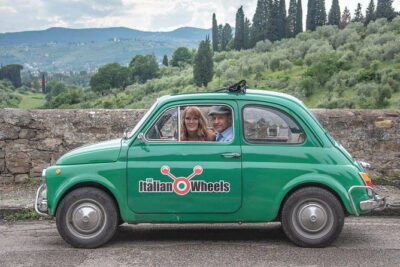
Self-Drive Vintage Fiat 500 Tour from Florence: Tuscan Hills and Italian Cuisine
Read our review →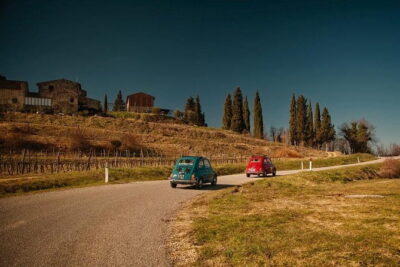
Self-Drive Vintage Fiat 500 Tour from Florence: Tuscan Wine Experience
Read our review →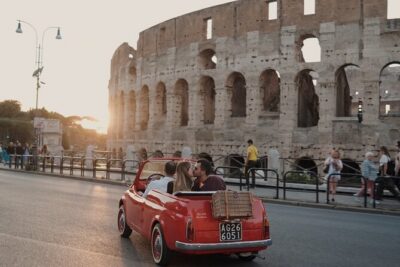
Vintage Fiat 500 Cabriolet: Rome’s Highlight Semi Private Tour
Read our review →
Browse the lists this tour appears in