
Reviewed · HERCULANEUM TOURS
Herculaneum Small Group Tour and Ticket With an Archaeologist
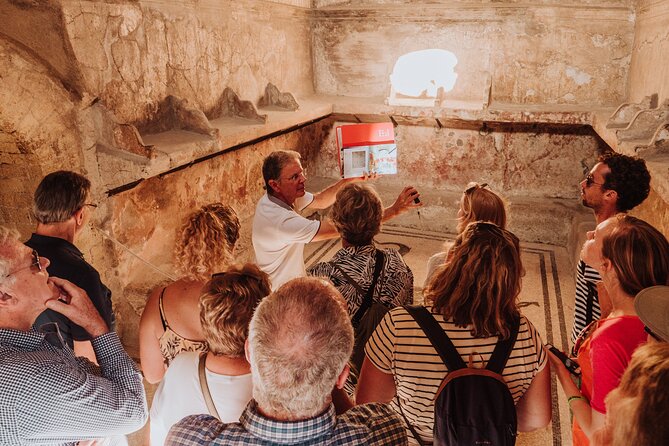
What makes this experience so interesting is that you walk through Herculaneum while an archaeologist helps you read the site in real time, brick by brick and room by room. It is not just a pretty walk, it is archaeology with context, and small-group size keeps the pace human.
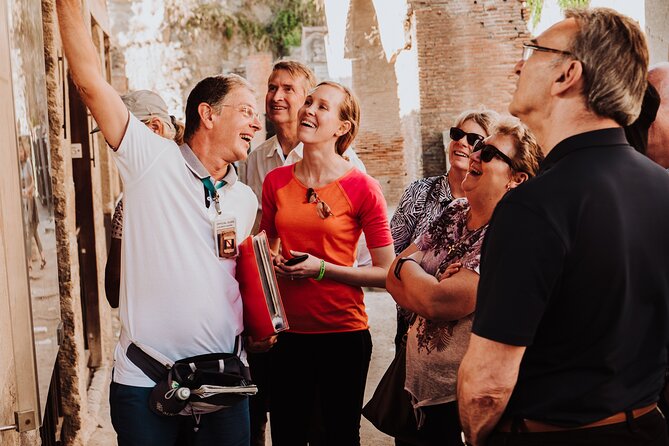
I like two things a lot. First, you get skip-the-line tickets, so you avoid long queue time and get moving faster. Second, you get headsets, which means the guide’s explanations stay clear even when the group is looking at different details.
One possible drawback to flag: the tour is a walking circuit with limited breaks, so you should expect standing and walking for close to the full 2 hours.
Key highlights worth planning for
- Skip-the-line entry so you start seeing things instead of waiting
- Headsets included for clear audio, even in a crowd of 20
- Archaeologist background with explanations that connect buildings to daily life
- A focused route through major houses, baths, and civic spaces in about 2 hours
- Museum time is on you after the walk, so don’t book tight connections
- All-weather operation, so pack for rain and slippery stone
Two Hours in Herculaneum, with an Archaeologist in Your Ear
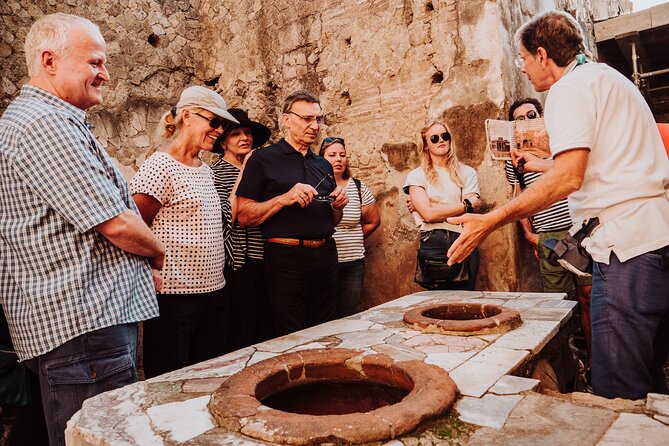
This is a small-group walking tour of Herculaneum in English, run by Askos Tours, with a maximum of 20 people per guide. The total time is about 2 hours, and you finish inside the Herculaneum ruins.
The biggest practical win is that the guide does not just point. You get guided explanations that help you notice what matters: how rooms connect, what kinds of statues or frescoes were placed where, and why certain buildings were important. Some of the guides people often get, like Michaele, Paulo, Julia, Luciano, and Antonella, have a knack for storytelling without getting sloppy. You also tend to move at a steady pace, which is great when you have limited time in the Naples area.
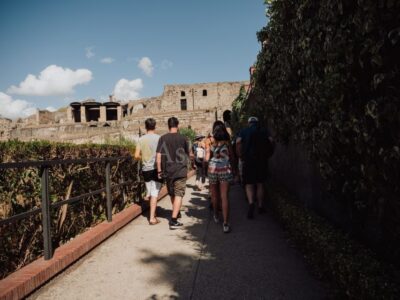
You will still do plenty of walking on uneven stone paths. This is not a sit-down show, so if your legs need breaks, plan for it. One review note I like to take seriously: the tour can involve a lot of standing, with little chance to pause.
More of Herculaneum:
- Herculaneum: Skip-the-Line Guided Tour with Archaeologist
★ 4.8 · 3,439 reviews - Herculaneum: Skip-the-Line Entry Ticket with Audio Guide
★ 4.3 · 870 reviews - From Naples: Pompeii & Herculaneum with Archaeologist Guide
★ 4.8 · 665 reviews
Price and value: what you are really paying for
The tour price is $53.81 per person for the guided experience plus Herculaneum entry tickets. The standard adult entry ticket price is listed as 16 euros, with 2 euros for EU citizens ages 18 to 25.
So how does that value math feel in real life? You are not just buying admission. You are paying for:
- a licensed guide with an archaeological background,
- skip-the-line access,
- and headsets so you can hear well.
Given that this is commonly booked about 42 days in advance, it is also a sign the experience is in demand. If you want a smoother arrival and fewer time-wasters, booking ahead is smart.
Getting to the meeting point at Ercolano
The meeting point is the Herculaneum Ticket Office, and the tour start listed is Corso Resina 187, 80056 Ercolano NA, Italy. The end is inside the Scavi di Ercolano.
If you are driving, the instructions say there is not guarded parking very close to the meeting place on via Pignalver. If you are using transit, it is easiest to aim for the Circumvesuviana train station at Corso Resina 1, then walk about 10 minutes.
My practical tip: get to the ticket office a bit early, even though the tour includes skip-the-line entry. The meeting time is how you avoid stress when the group is forming.
The walk through Herculaneum: what each stop teaches you
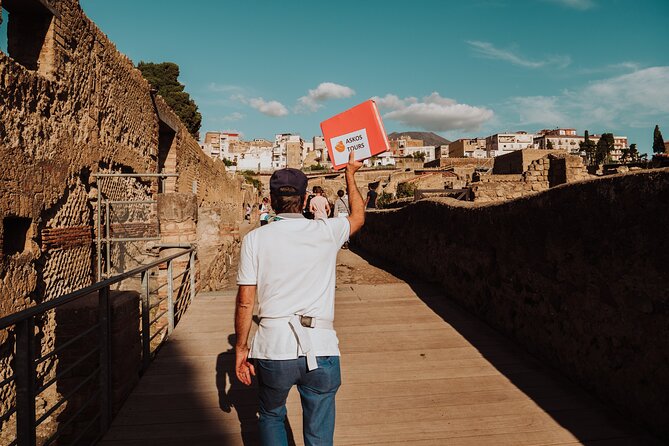
This route is built around a sequence of major houses, plus baths and civic sites. Each stop is roughly 10 minutes, which keeps you from spending your whole time staring at one corner.
Here is what you can expect as you move through the town.
More from a Naples stay:
- From Naples: Pompeii Ruins & Mount Vesuvius Day Tour
★ 4.3 · 11,459 reviews - From Naples: Sorrento, Positano and Amalfi Full-Day Tour
★ 4.6 · 10,988 reviews - From Naples: Sorrento, Positano & Amalfi Coast – Small Group Tour
★ 5.0 · 8,643 reviews - Naples: Catacombs of San Gennaro Entry Ticket & Guided Tour
★ 4.6 · 7,941 reviews
House of the Deer, named for the art in the peristyle
This house gets its name from marble statues of stags or deer found in the peristyle. The peristyle is one of those architectural words you hear for a reason: it is a key courtyard-like space that helps define how the home functioned and where people gathered.
If you like noticing clues, this is a good opener. The guide’s job here is to show you how the decorative program was not random, it was tied to status and taste.
La Terrazza di M. Nonio Balbo, plus a benefactor’s story on stone
Next up is the La Terrazza di M. Nonio Balbo. M. Nonius Balbus was the city’s major benefactor, restoring and building public buildings. When he died, he was honored through a long inscription on his funeral altar.
This stop is useful because it gives you a name and a reason. Suddenly Herculaneum is not only “ruins,” it is a place with political support and visible civic pride.
College of the Augustales, where religion and local power overlap
The College of the Augustales is thought to be a center connected to the cult of Emperor Augustus. It may have served as headquarters for the Collegium Augustalium, or even the local curia, depending on interpretation.
This is one of the spots where the guide’s explanation really matters. You are not just looking at walls, you are trying to understand what kind of gathering and authority happened inside.
Casa del Rilievo di Telefo, with its private link to the baths
The Casa del Rilievo di Telefo likely belonged to one of the town’s leading benefactors, possibly Marcus Nonius Balbus. What makes it unusual is that it has its own private access to the adjoining Suburban Thermae to the south.
Even if you are not an architecture nerd, this kind of detail connects the dots between private life and public facilities. It also helps you imagine daily routines.
Partem Domus lignea, famous for the wooden partition
This stop highlights Partem Domus lignea, specifically the Casa del Tramezzo di Legno. It is described as especially important because it preserves an elegant wooden partition.
Wood is fragile, so when you find evidence of it, it becomes a major clue for how rooms were organized. Expect the guide to point out why the partition style is significant, not just that it exists.
House of the Skeleton, a stark reminder of the human side
The House of the Skeleton is named from discoveries made in 1831, when human remains were found in a second-floor room.
This stop can feel heavier than the others, and that is normal. A good archaeologist guide keeps it factual and careful, helping you connect the moment of discovery to what the site preservation can still tell us.
Central Thermae, with men and women baths in separate entrances
The Central Thermae were built around the beginning of the 1st century AD. Like common practice of the time, they were divided into men’s and women’s baths, each with its own separate entrance.
This is the practical “how life worked” stop. After this, you can look at other rooms with a better sense of movement and routines.
House of the Black Salon, luxury with charred doorframe evidence
The House of the Black Salon is one of Herculaneum’s more luxurious mansions. Look for the monumental entrance, and notice the carbonised remains of the doorposts and lintel that are still visible.
This is also a great example of why a guide matters. You are seeing damage, but the guide helps you understand what features were once there and how the entrance signaled status.
Casa Sannitica, Samnite-style design and frescoed rooms
The Casa Sannitica has an arrangement typical of the Samnites, an ancient people from mountainous central Italy. The atrium is skirted by a gallery with Ionic columns, and the rooms include frescoes.
If you like variety, this stop adds a cultural texture to the story, showing how design choices reflect wider regional traditions.
Casa del Bel Cortile, a courtyard layout that breaks expectations
The Casa del Bel Cortile is described as one of the most original houses in Herculaneum. Instead of an atrium, it has a courtyard with a stairway and a stone balcony.
This is where you start seeing how architectural choices shape how people moved through space. It is also a reminder that “Roman house” is not one single template.
House of the Grand Portal, charred wood and central location
The House of the Grand Portal sits in the centre of the archaeological area. It includes various environments and collonnati, along with frescoes. The site preserves charred remains of wooden parts, which makes the “before and after” contrast easier to grasp.
This is a strong capstone. You finish with an overall sense of how grand entrances, wall art, and everyday function worked together.
What I really like about the best guides on this route
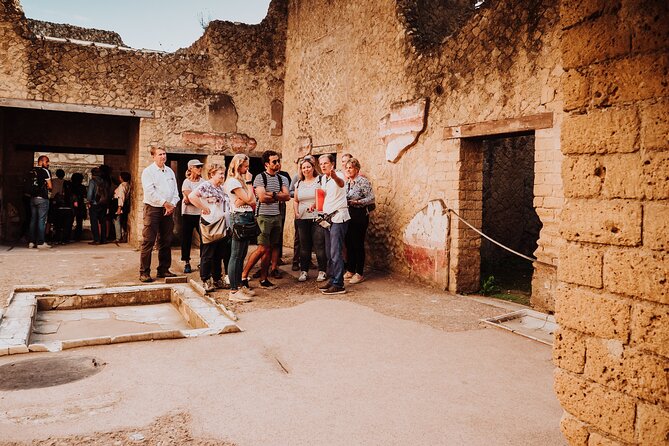
The difference between a decent walk and a great one is how the guide connects details. In this tour’s case, the archaeologist guides you might get, including Michele, Paulo, Gennaro, Julia, Luciano (often noted as Luciano Leone), Diego, Marie, Sergio, and Antonella, often share a similar style: clear explanations, good pacing, and a habit of pointing out small things you would miss.
A standout example from guide style: Luciano is frequently praised for being both entertaining and backed by real work in archaeology, plus using visual reconstructions to show how structures likely looked around 2,000 years ago. That matters because it turns charred wood and exposed foundations into a coherent picture of daily life.
There is also a practical audio advantage. With the headsets, the guide’s voice stays understandable. One helpful note tied to hearing aids is that the guide checks you can hear well, which is a small gesture that makes a big difference during a 2-hour explanation.
The main caution on guide performance is not about expertise. It is timing and pacing. One experience note mentioned a guide running overtime and causing the group to miss part of the on-site museum time. If you care about museum browsing, give yourself slack.
Museum time: plan it like it matters
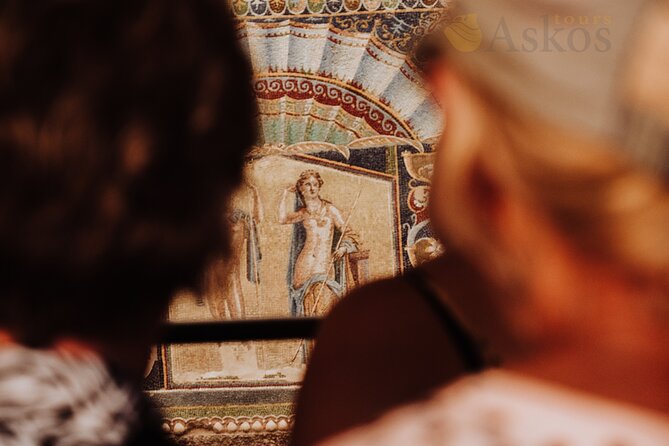
Your guided walk ends inside the ruins. Since the tour includes the site entry ticket, you can usually carry on into the on-site museum area at your own pace.
A practical way to do this: arrive with time cushion after the tour so you can see recovered objects such as jewelry and furniture displays. If your schedule is tight, you may end up prioritizing one or the other. The tour is packed, so treat the museum as the follow-up, not a guaranteed add-on within the tour window.
Also, note that the site is described as operating in all weather. Rain is common enough here that it pays to bring rain gear or a compact umbrella and plan for slippery surfaces.
Pace, comfort, and weather: what to expect on your feet
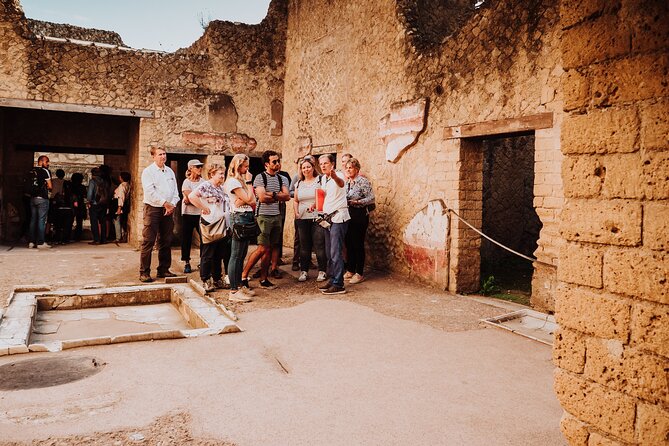
This is a standing-heavy visit. Even with 10 minutes per stop, you will spend a good chunk of the time on your feet, moving from doorway to doorway, courtyard to bath areas, and back again.
So pack for comfort. Wear shoes with good grip and dress in layers. If it rains, expect the stone to feel slick. The tour runs in all weather conditions, which is convenient, but it means your shoes and outerwear matter.
If you have someone in your group who needs more seating time, consider whether a shorter stop-by-stop plan works better. The tour is designed for a fast, information-forward visit.
Who this tour fits best
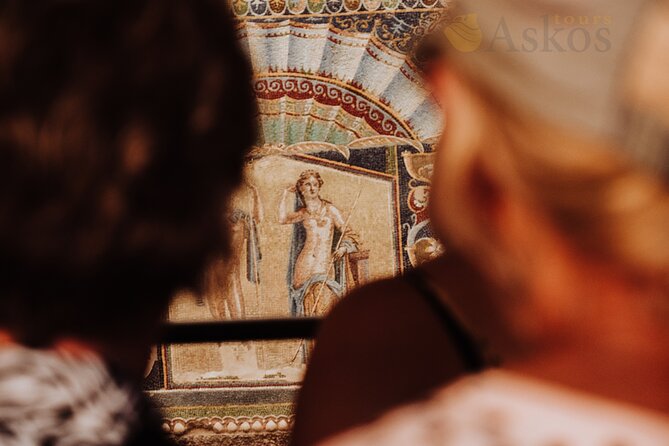
I think this is a great match if:
- you want context while you walk, not just photos and plaques,
- you have limited time and want a structured route,
- you enjoy houses, baths, and daily-life details rather than only big civic monuments.
It may not be the best fit if:
- you want lots of sitting,
- you have a very tight connection right after the 2-hour window,
- or you struggle with uneven walking surfaces.
It is also listed as “most travelers can participate,” and service animals are allowed. Dogs are allowed in the Herculaneum Archaeological Park with leash or muzzle rules, and you must have bags for droppings. There are extra access rules in specific areas like the Antiquarium premises, the Boat Pavilion, and domus with mosaic floors, where dogs are only allowed if carried in arms or in an appropriate carrier.
A few practical tips that will make the tour feel easier
- Use the headsets correctly. Put them on right away so you do not lose the first explanations while you are fiddling.
- Bring a light layer for shade and wind. The site is outdoors, and weather changes can be real.
- Plan museum time separately. If you want the on-site museum displays, do not schedule your next activity immediately after the tour end.
- If you care about hearing every detail, pick up where the guide stops and do not drift too far during transitions.
Should you book this Herculaneum small-group archaeologist tour?
I would book it if you value guidance with real archaeological framing. The combination of skip-the-line entry, headsets, and an archaeologist-led route through high-impact spots like the baths and major mansions makes the $53.81 feel like more than a sightseeing add-on.
I would think twice if your priority is a relaxed, slow visit with many pauses. This tour is structured and moving. If that sounds exhausting, you might prefer spending more time self-paced inside the ruins and museum.
Bottom line: if you want to leave Herculaneum with a clearer picture of how people lived, not just what is broken, this is a strong choice, especially with the small group size and the guides who bring the site to life with careful detail.
FAQ
How long is the Herculaneum small group tour?
The tour lasts about 2 hours.
How many people are in the group?
The group is small, with a maximum of 20 travelers per guide.
What language is the tour offered in?
The tour is offered in English.
Where do we meet, and where does the tour end?
You meet at the Ticket Office of the Herculaneum ruins. The tour ends inside the Herculaneum ruins.
Does the tour include skip-the-line entry?
Yes. It includes skip-the-line tickets so you do not wait in long queues.
Are the entry tickets included in the price?
Yes. The entrance fee for Herculaneum is included in the tour price.
Are meals included?
No. Meals and drinks are not included.
Reviewed lately around Naples
- Naples: National Archaeological Museum of Naples Guided Tour★ 4.8 · 498 reviews
- Naples Pasta Class: Fettuccine & Ravioli with Grandma’s Recipe★ 5.0 · 506 reviews
- Naples Walking Tour with Underground Roman Ruins Ticket★ 4.5 · 510 reviews
- Private Day tour of Positano, Amalfi and Ravello from Naples★ 5.0 · 522 reviews
- Naples: Street Art & History Tour in the Spanish Quarters★ 4.9 · 540 reviews
- Private Day Tour: Sorrento, Positano, Amalfi, Ravello from Naples★ 4.5 · 546 reviews
- Day Trip of Pompeii, Herculaneum and Vesuvius from Naples★ 4.5 · 547 reviews
- Day Trip of Pompeii, Sorrento and Positano from Naples/Salerno★ 5.0 · 560 reviews
Herculaneum Tours, compared.

Herculaneum: Skip-the-Line Guided Tour with Archaeologist
Read our review →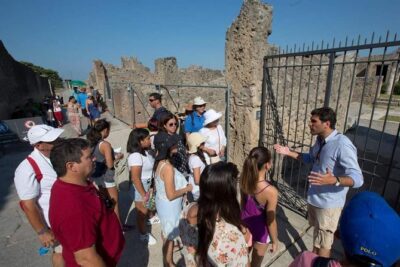
Pompeii and Herculaneum Small Group Tour with an Archaeologist
Read our review →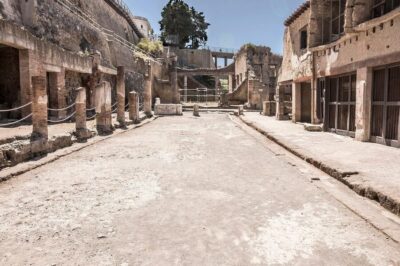
Herculaneum: Skip-the-Line Entry Ticket with Audio Guide
Read our review →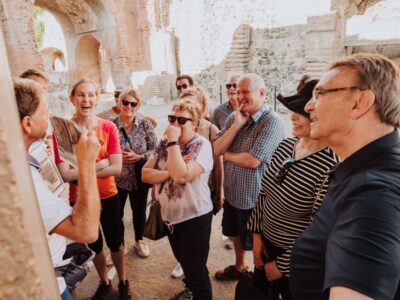
Pompeii & Herculaneum with Archaeologist Guide
Read our review →
Pompeii, Herculaneum, & Vesuvius Full-Day Tour
Read our review →
Ercolano: Herculaneum Entry Ticket with Optional Audio Guide
Read our review →
Day Trip of Pompeii, Herculaneum and Vesuvius from Naples
Read our review →Browse the lists this tour appears in